Reincarnation in cultures and religions – our view
Autor: D. Harald Alke
A standpoint, not a lexicon entry. An expressly worldview-based statement by the Kyborg Institute (author: D. Harald Alke). Neutral background knowledge on the term is in the lexicon entry Reincarnation.
Reincarnation is the idea that the soul returns to a new life after death. From our point of view it is not a proven fact, but a worldview-based way of looking at life – one that many cultures and religions have read in quite different ways for thousands of years. This article places these readings and describes how we ourselves regard the theme.
How did reincarnation drop out of Christian thinking?
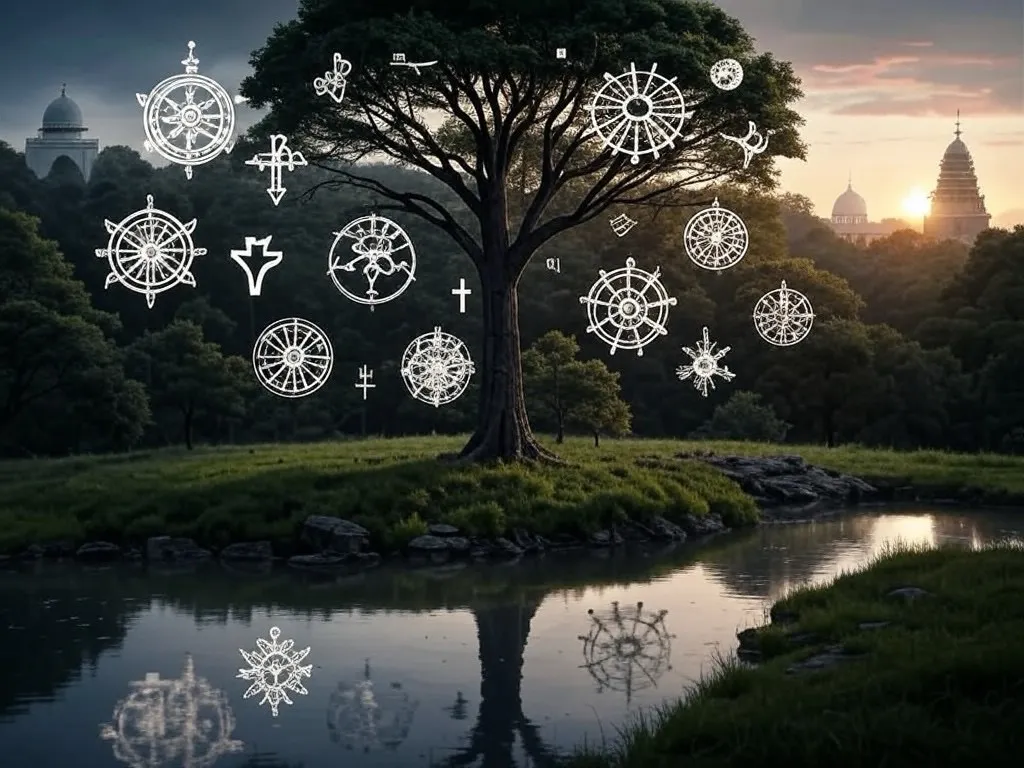 AI illustration
In the Christian tradition the idea of reincarnation plays hardly any role today. Reference is often made to the Council of Constantinople in 553 AD, in whose context certain teachings about the pre-existence of the soul were condemned. From our point of view, this brought to the fore the message: “You live only once, and after that comes the Last Judgment.” We observe critically that such images – purgatory, punishment, the one decisive life – have historically been much bound up with the notion of guilt and pressure. That is our reading, not an established historical fact; there is a scholarly debate about the dating and reach of the council.
At the same time there are passages in the Bible that, from our point of view, can be read in the sense of a rebirth. Thus Jesus asks his disciples: “Who do people say that I am?” – and they answer that some hold him to be the returned Elijah, an old prophet. We understand this as an indication that the thought of a return was at least known in earlier times.
What role do energy and relics play?
In Catholicism relics are important – for instance pieces of bone of saints, to which a special effect is ascribed. From our point of view, such an effect cannot come from the bone itself. But if one assumes that a kind of spiritual “pool” of a person continues on beyond death, the veneration of relics would make sense. Harald Alke reports from his own experience of once having held in his hand a cave-bear bone around 40,000 years old, which for him had an unusually strong radiance. That is a subjective perception, not a measurable finding.
How do other religions and indigenous peoples read the theme?
Very many cultures know reincarnation and karma and deal with them differently – for instance the indigenous peoples of America, Africa and the Arctic, as well as the great region from the Philippines through Indonesia to Malaysia. These animist religions assume that everything is ensouled, and know conceptions of spirits, otherworldly realms and a cycle of life. Shamans seek contact with these levels. We describe this as cultural and religious practice, without asserting its truth-content.
In Islam too a return from the dead is in part held to be possible, though not as the rule; to the fore stands the hope of a life in paradise. For Hindus and Buddhists, in turn, rebirth is often understood as a consequence of earlier action. Those who are educated and religious often strive to free themselves from the “wheel of rebirth” by laying aside needs and attachments, in order eventually to be born no more.
How do we see the idea of escaping the “wheel”?
From our point of view, this release is only one of several possible attitudes. We observe that in many societies – independently of religion – the high ethical claims and the lived reality differ markedly. For us this is no reproach to individual religions, but a general human observation: systems of belief are often lived differently from the way they are taught.
The idea that everyone is themselves responsible for their circumstances of life has, from our point of view, its limits. It makes a difference whether one despises other people or accepts them as they are. Whoever is in a better position can be a teacher to others – though we believe that people frequently need their tasks and difficulties in order to mature through them, and that too quick a “liberation” from them seldom helps.
What do individual spiritual thinkers say?
Thinkers such as Shankara and the Yogavasistha likewise speak of the wheel of rebirth, but point out further possibilities. According to this view, much exists simultaneously, and a person could, as it were, be transferred from one life into another – consciously or unnoticed. In doing so, so the tradition holds, one fits seamlessly into the new surroundings, so that others do not notice the “newcomer” at all.
“Only the one is free who no longer craves liberation.” – Yogavasistha
This attitude comes, from our point of view, close to what Harald Alke describes as the explanations of the figure Horus: Horus speaks of facet-worlds that overlay one another in infinite variety with tiny energetic deviations, and of our perhaps existing in many of these planes at once. That is a spiritual conception, not a scientific model.
If one follows this, so our reflection goes, the two do not exclude one another: the accustomed life with birth and death and a later new incarnation – and at the same time the possibility of “changing the plane”, so that we notice only that we remember events or people differently from the way they now present themselves. Do you know the feeling that something has “always been so”, although you remember it otherwise? Harald Alke calls this a “change of planes” – a personal reading of such experiences.
Reincarnation as suffering or as joy?
Hindus and Buddhists often try to escape the wheel – understandable, when life is experienced above all as suffering. But alongside this there is also a creative, life-affirming reading, for instance in the Mundaka Upanishad: all life springs from joy, and the original creative power Brahman divides itself in order to experience and unfold itself. From our point of view, much speaks for taking an active part in life and increasing its variety, rather than withdrawing from the process of life.
Whether there is a final dissolution in Nirvikalpa Samadhi without return, we deliberately leave open. Harald Alke describes his own meditation experiences, in which consciousness was completely extinguished and afterwards reappeared at a distant place – deep in the universe or even in another universe – while the mind still knew exactly where the body rested in trance. Such accounts render subjective inner experiences; they are not verifiable statements about the world.
What do we take from this?
For us, life is fascinating, manifold and greater than we can grasp. We believe that it is worthwhile to strive for higher consciousness, for deeper insights and for the conscious perception of the energy that is available to us in any case. Thus we contribute, to put it in an image, our small experiences as puzzle pieces to a larger whole. That is our worldview-based view – an invitation to one’s own reflection, not a claim to established truth.
“From joy all creation springs, by joy it is sustained, towards joy it proceeds, and into joy it returns.” – Mundaka Upanishad
© Kyborg Institute, Harald Alke (dha)
Frequently asked questions
What is reincarnation?
The idea that the soul returns to a new life after death. From the view of the Kyborg Institute it is not a proven fact, but a worldview that many cultures have shared for thousands of years.
Is reincarnation proven?
From our point of view, reincarnation is not a proven fact, but a worldview-based way of looking at life. Natural science can neither prove nor disprove it.
How do different religions read reincarnation?
Very differently: Hinduism and Buddhism as a consequence of action (karma), animist religions within the cycle of life; in Christianity the idea plays hardly any role today. The article places these readings.