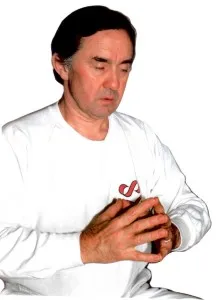
The Kyborg Institute – K.I. for short – is a spiritual educational and research initiative from Flörsheim-Dalsheim (Rhenish Hesse). “Kyborg” stands for Kundalini Yoga based Organisation (not for “Cyborg”). Founded by D. Harald Alke (Brahm Atma Singh), the institute joins three strands – the breath and consciousness work of Energytraining, the collected knowledge of its encyclopedia and the Horus Energy Pyramids as artistic objects – with a clear attitude: self-responsibility and a spiritual yet technology-friendly worldview.
“Life speaks to you”
A yogi sat in his cave and meditated. Then a little mouse came and rummaged in the leaves of his bedding. The yogi was disturbed and said: “Can you not be quiet? Do you not see that I am sitting here to unite in samadhi with the highest divine consciousness?” The little mouse replied: “How do you intend to cope with the highest divine consciousness if you already have problems with me, a small mouse?”
This little story sums up the institute’s attitude well: spirituality is nothing lofty, but shows itself in how we deal with the everyday.
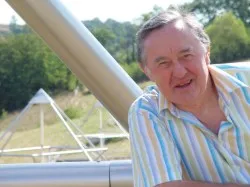
What the Kyborg Institute wants
The aim of the institute is to activate, research, develop and use the mental capacities of the human being – and to establish a conscious interplay between the human being and what we call the cosmic consciousness, between matter and spirit.
In our view, a practical experience is worth more than a thousand reflections without practice. Only practice effectively widens one’s own horizon. This includes the willingness to take responsibility for one’s own life – “yoga” means, in essence, “to place oneself under the yoke”, that is, to accept responsibility.
“The spirit shapes the universe, the word our world. Science and technology can describe it or imitate parts of it. Be aware: there is life in everything – and you are the shaper of your life.”
For us, technology and spirituality are no contradiction – even “WWW” can be read as a symbol of a vibration, and it is only through vibrations that communication arises. Technology alone is not enough for us; it unfolds its meaning in interplay with a spiritual consciousness.
The root: Kundalini Yoga
The institute builds on traditional Kundalini Yoga after Mahan Tantric Yogi Bhajan (1929–2004). In our view, Kundalini Yoga is one of the oldest handed-down sciences of the human being. A special significance falls to the mantras and the breath – in our experience they make higher mental levels tangible and give new impulses.
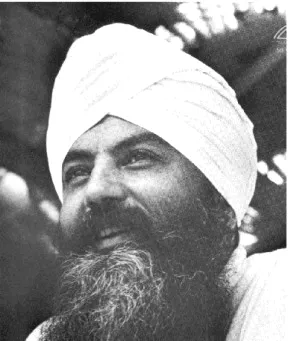
Mahan Tantric Yogi Bhajan (1929–2004)
The teachers: a line of masters
From 1976, Harald Alke went through around 14 years of spiritual training under the guidance of various teachers: Kundalini Yoga & Tantra with Yogi Bhajan, Zen with Roshi Tetsuo Nagaya, as well as formative encounters with the philosopher Lanza del Vasto and the medicine man Phillip Deer.
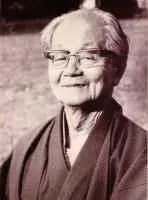
Roshi Tetsuo Nagaya Kiichi (1895–1993) – Zen master. He studied philosophy and ethics in Berlin and Marburg from 1923 to 1925 (including with Heidegger and Rudolf Otto), later taught at the Imperial University of Tokyo and, from 1967 onwards, came again and again to Germany to teach Zen. His guiding words: “Be awake – I want to become one with everything: awake, earnest, alive, attentive.”
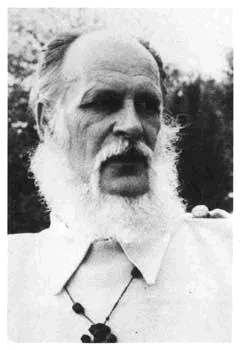
Lanza del Vasto (1901–1981) – poet and Christian mystic, born in southern Italy, with a doctorate in philosophy in Florence. In 1937 he met Gandhi; later he founded the community “The Ark”. He encouraged Harald to go his own way and to build up his own organisation.

Phillip Deer (1929–1985) – medicine man of the Muscogee Creek. In 1977 he came, with other representatives of indigenous peoples, to a conference in Geneva to speak about the situation of Native American culture. His concern: to keep awake an awareness of indigenous peoples and of nature.
Timeline of the Kyborg Institute
- 1976 – Harald begins his spiritual path in the Hamburg Kundalini Yoga ashram.
- 1978 – He acquires a farm in the French Pyrenees (Ariège) and sets up his first training and therapy centre there.
- 1989 – Move into the premises in Flörsheim-Dalsheim; beginning of the work on the Horus Energy Pyramids (the double pyramid).
- 1990 – The designs for the seven models of the Horus Energy Pyramids are created.
- 1998 – Founding of the Alke GmbH Spirituelle Kunst & Magie for distribution.
- 1999 – Erection of the large pyramid installation in the South of France.
- 2019 – Tobias O. R. Alke takes over the management of Alke GmbH.
- 2022 – Tobias takes over the management of the Kyborg Institute (with the addition “Research”).
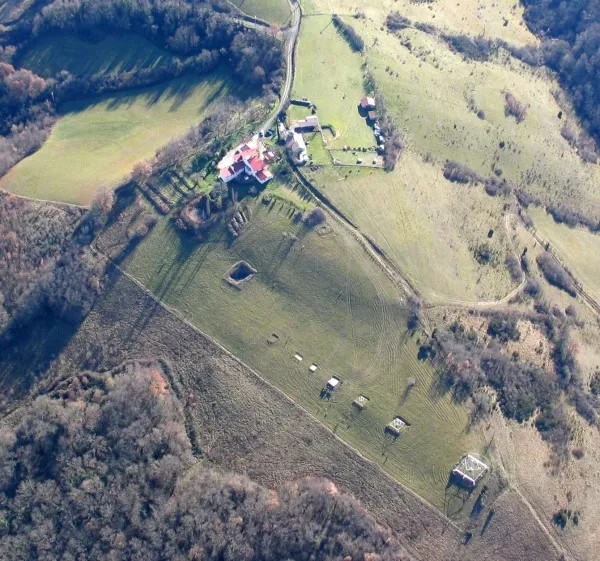
The pyramid installation in the South of France from the air.
The people behind the institute
D. Harald Alke (Brahm Atma Singh, born 1946) is the founder of the Kyborg Institute, a biotechnician, author and developer of Energytraining and of the Horus Energy Pyramids. His path joins a scientific training with a lifelong engagement with spirituality and self-responsibility.
Tobias O. R. Alke (born 1987, M.A. in sociology) is today the managing director of the institute. As the son of the founder, he grew up in his spiritual environment and joins a social-science training with lived spirituality and digital technology – a bridge between academic thinking and the tradition of the house.
→ More about the people: Authors of the Kyborg Institute
Horus as a frame of meaning
A formative part of the institute’s history is, for Harald Alke, the work with Horus, whom he has described since 1989 as his spiritual mentor. These channelings are an expression of our personal worldview and a frame of meaning in which the institute interprets its work – they are not scientific proof.
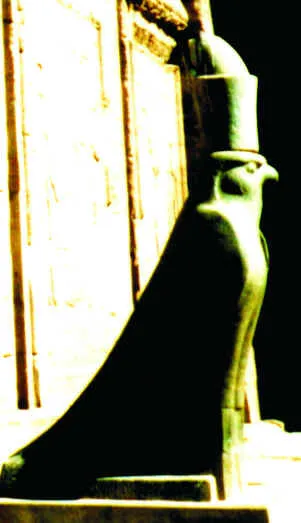
In this worldview, ideas such as rebirth also play a role. We understand them as a meaning-giving perspective on one’s own life, not as a provable fact – anyone who wishes can read the thought as an invitation to deal more calmly and more connectedly with others.
The spiritual path: seeker, teacher, knowledge
For the spiritual path, in our view, three things are needed: the seeker, the teacher and the knowledge (e.g. in books). None of them is enough on its own. The seeker needs the knowledge – and must see that others have walked the path; that is what the teacher is for. The knowledge in a book, in turn, only benefits the one who reads it, understands it and applies it with perseverance.
The way in which a teacher conveys their knowledge is what the Japanese call Ki. Ki is at the same time the wordplay behind K.I. (Kyborg Institute) – not to be confused with AI = artificial intelligence (see Ki).
Sat nam, Ji! – a mantra: Sat = being, Nam = the name (to recognise and name), Ji = the soul, your self. In essence: “Recognise yourself as an individual being, recognise your soul.” In modern Hindi, Sat nam also sounds like “seven names” – a reference to the seven main chakras.
Who we are here for
Perhaps you are at a point where, outwardly, much is right – and yet a question remains: Was that all? This is exactly where we come in. We accompany people who want to trust their own judgement again and go their own way – honestly, without pressure and without ideology.
What you find with us:
- An honest space in which you can speak freely, without being judged or pushed into a victim role.
- Orientation instead of paternalism – we give information and various points of view; you have to decide for yourself.
- A clear, reliable framework and practical methods with which you sharpen your own perception and gain inner security.
- Your own experience instead of ready-made truths – we do not convince, we invite you to experience for yourself.
We promise no miracles and frighten no one. You walk the path yourself – we walk part of the way with you.
→ Personal & individual: Consultation · → Experienced in practice: Methods
Knowledge, method, experience – how it continues
The institute sees itself as an invitation to gather your own experiences step by step:
- Knowledge: In the encyclopedia we collect the terms and connections – evergreen and quotable.
- Method: The methods (Energytraining, Autogenic Training, Pranayama) make the work with your own energy tangible in practice.
- Objects: The Horus Energy Pyramids and the spiritual art of the institute are the creative side of this work.