The Good in the Human Being in Friedrich Nietzsche
Autor: Tobias O. R. Alke
A standpoint, not a lexicon entry. This article is a scholarly and at the same time expressly subjective engagement – an excerpt from the specialist book „Ausgewählte Perspektiven des Altruismus” (Selected Perspectives on Altruism; Tobias O. R. Alke, 2017). The neutral background knowledge on the theme is in the lexicon entry Loving-kindness & altruism. A reading is advanced here, not a last word.
Translator’s note: the primary quotations from Nietzsche are retained verbatim in the original German from the cited critical edition (Colli/Montinari, Kritische Studienausgabe), with the page references preserved – translating them would break the exact citation. English translations are available in standard editions. Likewise, the bibliography and source citations remain in the original.
Friedrich Nietzsche is often read as a despiser of compassion and an advocate of pure egoism – as though the good in the human being did not exist for him. This picture falls short. If one reads the guiding threads of his writings together, the opposite appears: behind his critique of “slave morality” there stands very much a concept of genuine, voluntary altruism – embodied in the “strong human being” who takes responsibility instead of ceding it to a dogma.
The following text is deliberately demanding and worked through with page references from Nietzsche’s work. For a first overview you may safely skip the citation references; in the quotations – as is usual in scholarly citation – the original spelling has been retained.
Altruism in Friedrich Nietzsche
With Friedrich Nietzsche, altruism is, according to Hillmann et al. (2007: 23), conceived of as „[…] als eine verdeckte, nivellierend wirkende Form des Egoismus schwacher Menschen (…) (→ Sklavenmoral)“ (ibid.). However, this formulation is only partly borne out, since precisely this slave morality is not altruism, unless one follows the exposition of Auguste Comte (see above) or Fehr/Gächter (see below). The following presentation of his philosophy will provide a clearer differentiation of the conception of slave morality (which can equally be understood as a critique of state altruism and of charity in general) and of what, even according to Nietzsche, can constitute real altruism. For even if Hillmann et al. present altruism according to Nietzsche as concealed egoism, he did nonetheless also formulate its opposite, real altruism!
To begin, I turn to the derivation and definition of slave morality in Nietzsche. According to his observations, the human being is (mostly) an instinct-driven being (Nietzsche 2010: 17) that seeks, in the mass, to secure a preservation of its way of life (ibid.), by which the centre of its egoism is in essence named, since the human being seeks to assert this against evolutionary changes (cf. ibid.: 325, 366). They simply resist their own nature. Yet only this resistance to natural evolution, the reluctance towards development (human-moral and not technological), the fighting of deviation from the old (the breaking with traditions in their central features; by this are meant not styles of clothing or a particular etiquette, but fundamental conceptions of good and evil, right and wrong, good and bad, which lie immanently at the basis of all these cultural differentiations of our society in their manifold milieus (and, strictly speaking, differentiate them into classes), simply as the result of a tradition lasting thousands of years) – this describes at its core the actual slave morality. Its representatives are the „asketische[n] Priester“ (ibid.: 361), its defenders the „Heerde“ (ibid.: 120; hereafter1 referred to as the herd) as the subordinate mass of the people, the „Schaf[e]“ (ibid.: 375) – the foot soldiers of the ascetic priests. These ascetic priests are by no means only religious leaders, even if here their strongest, or rather most traditional, presence is to be recorded. No, the ascetic priest appears in manifold forms, whereby one can distinguish them here in five groups: (a) the religious leaders (as pope, as rabbi, prophet, and the like), the (c) economic leaders (entrepreneurs, economists in general), the (b) political leaders (politicians, kings, dictators), the (d) scientific leaders (academics of all kinds) and the (e) cultural leaders (artists, musicians, actors, etc.). Yet let it be noted that these five groups are interwoven among themselves, and that at least in the history of humanity both political and economic leaders were (and probably in part still are) obliged to seek justification from religious leaders (cf. Nietzsche 2010: 71f), while Nietzsche sees the scientific leaders (among them in particular the philosophers) as closest to the religious ones, with the cultural leaders as lackeys of the other leaders (Nietzsche 2010). I will now differentiate these five groups and finally set out their instruments of power over the herd and the edifice of their dominance as rulers over the ruled, the order following the preceding arrangement of the various leaders.
What lies at the basis of all these ascetic priests is the defence of their ideals, as a kind of self-preservation drive in their „Heerden-Organisation“ (ibid.: 384). The life of the ascetic priest is an „Irrweg“ (ibid.: 362) in the confusion between his strength to bind the masses and at the same time to follow his religion of suffering, which holds him in a lasting contradiction with himself and hinders, or at least slows, the way to knowledge, to the recognition of reality and thereby of himself. „[…] [D]ie kleine Freude [an] der ‚Nächstenliebe‘ […]“ (ibid.: 384), „[…] die Erweckung des Gemeinde-Machtgefühls [und] der Verdruss des Einzelnen […]“ (ibid.) is his support. He corrupts the „[…] seelische Gesundheit […], wo […] auch [immer er] zur Herrschaft gekommen ist […]“ (ibid.: 392). Their perhaps most important representatives are the ascetic priests of the great religions.
The ascetic priests of the religions
The asceticism of the religions owes its success and its durability to the authoritarian „Tyrannei“ (ibid.: 218) from without, through rulers and barbarians, and offers refuge in great works such as the „ B i b e l “ (ibid.), which for their part, however, represent the second step of his „[…] grosse[n] Leiter der religiösen Grausamkeit[en] […]“ (ibid.: 74). Thus Nietzsche distinguishes the three most important groups of these religious cruelties (of their dogmas) in three epochs (cf. ibid.):
(1) The „Vorzeit-Religionen“ (ibid.), which offered their god human sacrifices, and indeed precisely such „Menschen“ (ibid.) as were dearest to one, which he calls the „Erstlings-Opfer“ (ibid.).
(2) The „[…] moralisch[e] Epoche der Menschheit […]“ (ibid.), which sacrifices to its „[…] Gotte die stärksten Instinkte […]“ (ibid.), „seine ‚Natur‘“ (Nietzsche 2010: 74), „[…] allen Glauben an verborgene Harmonie, an zukünftige Seligkeiten und Gerechtigkeit […]“ (ibid.).
(3) The sacrifice of God himself, as „Grausamkeit“ (ibid.) against oneself. „Für das Nichts Gott opfern — dieses paradoxe Mysterium der letzten Grausamkeit blieb dem Geschlechte, welches jetzt eben her- auf kommt, aufgespart: wir alle kennen schon etwas davon. —“ (ibid.)
Nietzsche regards the dogmas of the great religions (especially of Christianity) as the embodiment of all sacrifice of freedom (in the sense of loving-kindness in Comte (see above)), „[…] Stolz [und] Selbstgewiss- heit des Geistes […]“ (ibid.: 66), which issues in a „Verknechtung“ (ibid.) of the self in the service of the authorities. An obvious conclusion, if one considers the Fall (Luther 1938) of the Old Testament (1st book, Genesis 2/3). Thus Adam and Eve were driven from Paradise because they dared to eat from the tree of knowledge, figuratively to break through an illusion and to develop themselves. Knowledge, as one understands it today, always has something to do with development. The empirical findings of a study are valuable insights for dealing better with the specific questions, and theoretical findings help us to interpret empirical findings better, or where appropriate to specify them better. In this sense the Bible stands in direct conflict with the holistic view, with a knowledge of connections in the environment, of removing veils and perceiving oneself better:
„[Mose 2.9:] Und Jehova Gott ließ aus dem Erdboden allerlei Bäume wachsen, lieblich anzusehen und gut zur Speise; und den Baum des Lebens in der Mitte des Gartens, und den Baum der Erkenntnis des Guten und Bösen. […] Mose 3: […] (5.) Sondern Gott weiß, daß, welches Tages ihr davon [dem Baum der Erkenntnis] esset, eure Augen aufgetan werden und ihr sein werdet wie Gott, erkennend Gut und Böses. (6.) Und das Weib sah, daß der Baum gut zur Speise und daß er eine Lust für die Augen und daß der Baum begehrenswert wäre, um Einsicht zu geben; und sie nahm von seiner Frucht und aß, und sie gab auch ihrem Manne mit ihr, und er aß. (7.) Da wurde ihrer beiden Augen aufgetan, und sie erkannten, daß sie nackt waren; und sie hefteten Feigenblätter zusammen und machten sich Schürzen. […] (11) Und er [Jehova] sprach: Wer hat dir kundgetan, daß du nackt bist? Hast du gegessen von dem Baume, von dem ich dir geboten habe, nicht davon zu essen? (12) Und der Mensch sprach: das Weib, das du mir beigegeben hast, sie gab mir von dem Baume, und ich aß. (13) Und Jehova sprach zu dem Weibe: Was hast du da getan! Und das Weib sprach: Die Schlange betrog mich, und ich aß. (14) Und Jehova Gott sprach zu der Schlange: Weil du dieses getan hast, sollst du verflucht sein vor allem Vieh und vor allem Getier des Feldes! Auf deinem Bauche sollst du kriechen und Staub fressen alle Tage deines Lebens. (15) Und ich werde Feindschaft setzen zwischen dir und dem Weibe und zwischen deinem Samen und ihrem Samen; er wird dir den Kopf zermalmen, und du, du wirst ihm die Ferse zermalmen. (16) Zu dem Weibe sprach er: Ich werde sehr mehren die Mühsal deiner Schwangerschaft, mit Schmerzen sollst du Kinder gebären; und nach deinem Manne wird dein Verlangen sein, er aber wird über dich herrschen. (17) Und zu Adam sprach er: Weil du auf die Stimme deines Weibes gehört und gegessen hast von dem Baume, von dem ich dir geboten und gesprochen habe: Du sollst nicht davon essen, so sei der Erdboden verflucht um deinetwillen: mit Mühsal sollst du davon essen alle Tage deines Lebens; […]“2 (emphasis by the author)
All the worse, then, is today’s „Abstumpfung“ (Nietzsche 2010: 67) of modern man towards the „christliche[n] Nomenklatur“ (ibid.), which has taken from him the awareness of these structures and has let the human being become a „zahme[s] Haustier“ (ibid.: 72) with the need for this morality (here one may recall Pavlov’s dog). This self-derision of the human being finds its expression in the „gefährlichen Diät-Verordnungen“ (ibid.: 67) of the „religiösen Neurose“ (ibid.): „[…] Einsamkeit, Fasten und geschlechtlicher Einsamkeit […]“ (ibid.). Sexual abstinence in particular Nietzsche counts among these „gefährlichen Diät-Verordnungen“ of the „religiösen Neurose“ – an enforced self-denial that separates the human being from their own nature.
In this, the „[…] ‚alte Testament‘ […]“ (Nietzsche 2010: 72) represents above all a division into „[…] ‚Gross‘ und ‚Klein‘ […]“ (ibid.), which in the further course of Nietzsche’s exposition can be understood as a class division into rulers and ruled (cf. ibid.: 80f), rich and poor, or strong and weak, on the basis of power.
Through its attempt to hold fast to everything conceivable in life, almost at any price, religion becomes a religion of the suffering, since through changes some things or persons will inevitably leave one’s life, or one simply loses sight of one another. In this morality of suffering they receive, through their clinging to the old and their fighting of development, the confirmation of their suffering by the great religions. Through this religious rejection of natural evolution, of the development of the human being, of society, of nature as such and of all the connected facets of knowledge, the dogmas of the religions invert the human being in their attitude to the environment and turn the actually necessary development into a resistance to their own existence. Formerly natural appreciations are reversed, the good becomes evil, development becomes a danger and is no longer regarded as an opportunity, joy becomes suffering, love becomes hatred (cf. ibid.: 82), mercy becomes revenge (Nietzsche 2010: 72-111).
The ascetic priests of the religions maintain their position by comforting the masses, their herd of people, who seek in religion their redemption through the alleviation of their morality of suffering – with which, admittedly, they have also again contributed to a certain development. Thus God sacrifices himself for the human beings, is the „Gläubiger“ (ibid.: 299) of their debts and delivers a comfort for their sufferings. Thus the believing religious person owes their dogma allegiance, and if they refuse it (by resisting this inhibition or deviating from the mass, no longer wanting to be a sheep), they deserve the „Strafe“ (ibid.: 302) – cf. on this the instruments of the ascetic priests further below (Nietzsche 2010: 190f, 282, 330ff, 377). Yet let it be emphasised that the religions as such do not constitute the problem of these ills, but rather their dogmas, which are derived from them (cf. ibid.: 73):
„Die neuere Philosophie, als eine erkenntnistheoretische Skepsis, ist, versteckt oder offen, antichristlich: obschon, für feinere Ohren gesagt, keineswegs antireligiös.“ (Nietzsche 2010: 73)
The ascetic priests of the economy
The basis of the general slave morality, a „Nützlichkeits-Moral“ in Nietzsche (2010: 211), is the invention of possession and property, „der Kitzel des Unendlichen“ (ibid.: 160) and „[…] eine[r] Art tropische[m] Tempo im Wetteifer des Wachsthums […]“ (ibid.: 216), an „explodierenden“ (ibid.) egoism (cf. ibid.), as a metaphor of the capitalism of modern man, a principle of the ever richer becoming rich (the possessing, the „menschlicher[en]“ (ibid.: 309)) and the ever poorer becoming poor (cf. ibid.: 183). The basis of this society is „ S k l a v e r e i “ (ibid.), the subjugation of the weak and the education of the human being into the weak, the sheep, into the „Selbst-Zerstör[ung]“ (ibid.: 203) of oneself „durch Arbeit“ (ibid.)3 in humility and diligence, as the only possible content of life (thus also Mauss4 1990: 174). Namely, „machinale[…] Thätigkeit“ (Nietzsche 2010: 382)5 in order to distract from the fact of suffering, through „absolute“ (ibid.) regulatedness (cf. ibid.), „[…] pünktliche[m] besinnungslosen Gehorsam, das Ein-für-alle-Mal der Lebensweise [und] Ausfüllung der Zeit [in] ‚Unpersönlichkeit‘ […]“ (ibid.), well on the way to forgetting one’s own self, to keeping the human being dampened in their sensibility (Nietzsche 2010: 382; cf. also Mauss 1990: 161). The foundations of this morality of the rulers are the past predominance of the religions, or rather of their dogmas, yet anchored still more deeply in the „Gefühl der Schuld“ (ibid.: 305) – and the morality of suffering as a requirement of life – „[…] der persönlichen Verpflichtung […]“ (ibid.) in the „[…] Verhältnis zwischen Käufer und Verkäufer, Gläubiger und Schuldner […]“ (ibid.), which are even „[…] älter als […] die Anfänge irgend welcher gesellschaftlichen Organisationsformen und Verbände […]“ (ibid.: 306; cf. ibid.: 210f). According to their morality, everything has its price, „[…] Alles kann abgezahlt werden‘[6] — dem ältesten und naivsten Moral-Kanon der G e r e c h – t i g k e i t , dem Anfange aller ‚Gutmüthigkeit‘, aller ‚Billigkeit‘, alles ‚guten Willens‘, aller ‚Objektivität‘ auf Erden“ (ibid.: 306). According to this principle of equalisation, the „Mächtige[…]“ (ibid.: 307), the possessing one, is entitled to „z w i n g e n “ (Nietzsche 2010: 306) the less powerful, the non-possessing, to „Ausgleich“, and to punish them in case of resistance (see further below in Instruments of the ascetic priests), in their „Vorrecht [als] Mächtigsten“ (ibid.: 309).
The ascetic priests of politics
The „Befehlenden“ (ibid.: 119) are the „moralische[n] Heuch[ler]“ (ibid.) of society, „[…] Eine Gattung öffentlicher und u n g e – f ä h r kunstmässiger Red[ner] […] von der Kanzel herab“ (ibid.: 190f). They regard the herd human being as the only permitted kind of human being. Their tool is the constitution and the command-needing herd human being as such, whereby this morality is designated as „H e e r – denthier-Moral“ (ibid.: 124). The organisation of the herd-animal morality is that of a Christian democracy in which the „[…] ‚Mitleiden[…] mit Gott‘ […]“ (ibid.: 125) is a central component. These commanders, in conflict with the other commanders (regarding „Buddhismus“ (ibid.)), proclaim the „[…] ‚allgemeine Wohlfahrt‘ […]“ (ibid.: 165; cf. ibid.: 127f) as the socialist virtue of society and as an „[…] unfreiwillige Veranstaltung zur Züchtigung von Tyrannen […]“ (ibid.: 183). They make use of the „Stände[…]“ (ibid.: 378) and thus divide people according to origin (bloodline) „und Rasse[…]“ (ibid.), and thereby likewise produce a feeling of inhibition in the masses.
The ascetic priests of the sciences
Among the scientists there prevails above all the need for self-presentation, especially among the philosophers (cf. ibid.: 19f), while their profession of growing knowledge is rather a „Trieb“ (ibid.: 20) of „Verkenntnis!“ (ibid.), and they lose sight of the actual purpose of the discussion through their manifold „Interpretation[en]“ (ibid.: 56). They determine the angles of research, according to the „[…] Princip der ‚kleinsmöglichen Kraft‘ […]“ (ibid.: 28), and in doing so lose sight of the great whole in their diversification of research (cf. ibid.: 132) into ever smaller sub-areas and disciplinary demarcation, in determining the foreign position as the fundamentally false one (simply because it is a different perspective) – something one can probably find intensified today in the exaggerated faith in statistics (cf. Wehr 2014). And so the scholar behaves in accordance with the masses in the goodwill of the authorities, and falls dutifully „in Reih und Glied“ (Nietzsche 2010: 133), rendering obedience to the authorities (Selke 2013), not least out of their „[A]bhängig[keit]“ (Nietzsche 2010: 134) on them:
„‚Wo der Mensch nichts mehr zu sehen und zu greifen hat, da hat er auch nichts mehr zu suchen‘ […]“ (Nietzsche 2010: 28)
Even the refutation of the „[…] Theorie vom ‚freien Willen‘ […]“ (Nietzsche 2010: 31), of individual freedom, as a confirmation of social determinism, seems much more a „Reiz[…]“ (Nietzsche 2010: 31), a drive of the scientist, than that it serves a real advance of knowledge – rather a misapprehension. Thus „[…] ‚Freidenkerei‘ […]“ (ibid.: 76) has „[…] die religiösen Instinkte aufgelöst […]: so dass sie gar nicht mehr wissen, wozu Religionen nütze sind, und nur mit einer Art stumpfen Erstaunens ihr Vorhandensein in der Welt gleichsam registrieren“ (ibid.) – whereby Nietzsche does not restrict this to scientists alone. His undoing is the „Mittelmässigkeit seiner Art“ (ibid.: 134), which stems from the „Jesuitismus der Mittelmässigkeit“ (ibid.). It springs from the pen of the „Religion des Mitleidens“ (ibid.), which seeks to suppress every uniqueness, the unusual in the human being, and to reduce as far as possible the strength of its „Bogens“ (ibid.) – metaphorically the reach of this uniqueness of the strong human being, who could reach the masses, the sheep, in order to seduce them to knowledge and lead them to mental independence – or even seeks to abolish it entirely, which finds its climax in the „[…] Entselbstung und Entpersönlichung des Geistes […]“ (ibid.: 135), the „[…] ‚interessenlosen Erkennen‘ […]“ (ibid.).
And this transfiguration of the spirit of the scholars is the fact that „[…] ‚Jeder […] sich selbst der Fernste‘ […]“ (ibid.: 248). And their debasement they find in the words of the philosophers „Thomas Hobbes“ (Nagel 2005: 19) – the compulsive preservation of the system – „David Hume“ (ibid.: 20) – the justification through self-preservation for the good of the majority, or rather of the dogma to which they render allegiance – and „Locke“ (ibid.: 195), who try to transfigure human „Natur“ (ibid. 236) and, through their „wissenschaftliche[…] Billigkeit“ (ibid.: 310), „[…] Hass, Neid, Missgunst, Argwohn, Rancune, Rache […]“ (ibid.) in the tradition „[…] des Ressentiment […]“ (ibid.) „als ‚Gerechtigkeit‘ […] heiligen“ (ibid.). And the greatest error is the fighting of their „aktive[n] […] Gefühls“ (ibid.: 311), the basis of initiative, of the readiness to act, whereby it has not least lost faith in itself and in its „[…] Selbst-Betäubung […]“ (ibid.: 396) already „[…] fürchte[t] [ z u ] B e w u s s t s e i n z u k o m m e n …“ (ibid.: 398):
„Der aktive, der angreifende, übergreifende Mensch ist immer noch der Gerechtigkeit hundert Schritte näher gestellt, als der reaktive; es ist eben für ihn durchaus nicht nöthig, in der Art, wie es der reaktive Mensch thut, thun muss, sein Objekt falsch und voreingenommen ab- zuschätzen. Thatsächlich hat deshalb zu allen Zeiten der aggressive Mensch, als der Stärkere, Muthigere, Vornehmere, auch das f r e i e r e Auge, das b e s s e r e Gewissen auf seiner Seite gehabt: umgekehrt erräth man schon, wer überhaupt die Erfindung des ‚schlechten Gewissens‘ auf dem Gewissen hat, — der Mensch des Ressentiment!“ (Nietzsche 2010: 311)
And their proximity to the „asketische[n] Ideal“ (Nietzsche 2010: 402) expresses itself most clearly in the „Verarmung des Lebens“7 (ibid.: 403f) of a „Gelehrte[n]“ (ibid.), through which they have even become a strengthening of this ideal, instead of seeing through it by knowledge and resisting this new dogma (cf. ibid.: 402), which mostly shows itself in the garb of positivism (ibid.: 131)8:
„[…] die Affekte [und Emotionen] kühl geworden, das Tempo verlangsamt, die Dialektik an Stelle des Instinktes, der E r n s t den Gesichtern und Gebärden aufgedrückt (der Ernst, dieses unmissverständlichste Abzeichen des mühsamen Stoffwechsels, des ringenden, schwerer arbeitenden Lebens).“ (Nietzsche 2010: 403)
The ascetic priests of culture
The „Künstler“ (Nietzsche 2010: 344) too are anything but independent, still less than the scholars, dependent on the favour of a „Gönner[s]“ (ibid.), in his service, in order to grant their visions free scope undisturbed (cf. ibid.: 344f):
„In unserem sehr volksthümlichen, will sagen pöbelhaften Zeitalter m u s s ‚Erziehung‘ und ‚Bildung‘ wesentlich die Kunst, zu täuschen, sein, — über die Herkunft, den vererbten Pöbel in Leib und Seele hin- weg zu täuschen.“ (Nietzsche 2010: 219)
Even „der Musiker“ (Nietzsche 2010: 346) now becomes an „[…] Orakel, [einem] Priester, [dieser] Bauchredner Gottes […]“ (ibid.) and proclaims the ascetic ideals and celebrates even the „Grausamkeit“ (Nietzsche 2010: 302) in „S t r a f e “ (ibid.: 305) as a „[ f ] e s t l i c h e r “ (ibid.) act. C. W. Mills (1962: 388) would here probably speak of the American Boy, while their most essential counter-bearing is the „[…] Kömodiant[…] dieses Ideals […]“ (Nietzsche 2010: 409), who awakens „Misstrauen“ (ibid.) and is able to bring the masses to reflection.
The instruments of the ascetic priests
The instruments of the ascetics have thereby already been mirrored in outline in the preceding explanations. The ascetic priests are bearers and servants of these ideals of suffering at once, and exploit the need for harmony (cf. ibid.: 19, 74) of the masses to their advantage, and veil their intentions in the dogmas they place as self-fulfilling „[…] Wahrheit[en] […]“ (ibid.: 23), whether these are of a religious, economic, political, cultural or otherwise constituted nature. „[…] [U]nser[e] [Körper sind] nur ein Gesellschaftsbau vieler Seelen […]“9 (ibid.: 33) with the will to self-preservation, the „Wille[n] zur Macht“ (ibid.: 27).
The need for harmony of the human being, especially of that human being who feels safe only as a sheep in the herd, is susceptible to the „Vordergrunds-Glaube[n]“ (ibid.: 26) of these various dogmas, with „Positivismus“ (ibid.: 23; cf. ibid.: 23f) on top with its „[…] Mitleid [als] gefälligste[r] Verkleidung“ (ibid.: 36). It gains its followers through „Sprach-Verwandtschaft“ (ibid.: 34), which lays the foundation for the „[…] ‚unfreie[n] Wille[n]‘ […]“ (ibid.: 36), which exists and also again does not exist (cf. ibid.: 36), for in the end life is a distinction into „[…] starken und schwachen Willen“ (ibid.: 36), not into free or unfree will (cf. ibid.).
Through the education of the human being into a herd-being, they recognise in every deviation a ressentiment against their existence („[…] jeder Umgang ist schlechter Umgang, ausser dem mit Seines-Gleichen […]“ (ibid.: 44)). Their own existence is adorned with „[…] Zauber und Zucker in jenen Gefühlen des ‚für Andere‘, des ‚nicht für mich‘ […]“ (ibid.: 52), whereby the „[…] moralische[…] Vorurtheil, dass Wahrheit mehr werth ist als Schein […]“ (ibid.: 53) is mere imagination. For this reason there is no one truth, since it is always bound to a morality, or rather its dogma (cf. ibid.: 54). Thus even „[…] ‚der alte Mensch‘ […]“ (Nietzsche 2010: 75) remains „ein ewiges Kind“ (ibid.), caught up in its dogma of truth(s). Under the cloak of these truths, ideals of beauty and appreciations, among other things, are inverted, and the human being is shaken in their foundations, yet in a controlled way under the continual protection of the majority, under the guidance of the ascetic priests, whose manner of implementation already borders on arbitrariness (cf. ibid.: 80ff, 109). In this education of the human being into a sheep in the herd lies also the chastisement of the human being „[…] innerhalb einer kirchlichen und höfischen Richtschnur […]“ (Nietzsche 2010: 109) into the enslavement of their spirit (cf. ibid.). In this „Heerden-Nützlichkeit“ (ibid.: 121) as a self-liberating working and consuming body lies their redemption through work, through service to the ruler, as the meaning of their life, the redemption from suffering. And those who resist, who wish to refuse allegiance to the system of suffering (for instance because they are not content with mediocrity and strive for something higher, for nobler values, or simply wish to consider the whole and not only specific sub-areas (cf. ibid.: 217, 277)), are threatened with exclusion or even persecution (cf. ibid.: 147):
„Heute umgekehrt, wo in Europa das Heerdenthier allein zu Ehren kommt und Ehren vertheilt, wo die ‚Gleichheit der Rechte‘ allzuleicht sich in die Gleichheit der Unrechte umwandeln könnte: ich will sagen in gemeinsame Bekriegung alles Seltenen, Fremden, Bevorrechtig- ten, des höheren Menschen der höheren Seele, der höheren Pflicht, der höheren Verantwortlichkeit, der schöpferischen Machtfülle und Herrschaftlichkeit […]“ (Nietzsche 2010: 147)
And the punishment that follows this deviation, as the representation and body of the „Sklaven-Moral“ (Nietzsche 2010: 270) by the masses as representatives of the ascetic priests, or rather of the dogmas to which both the sheep and the ascetic priests are obliged, constitutes this securing of collective compulsion, the calculability (cf. ibid.: 293) of the human being as a sheep in the herd and the fighting of uniqueness as an independently thinking being.
Yet without this uniqueness, these rule-breakers and outsiders (see the founder in Sigmund (see above)), slave morality would in turn lose its basis of existence, since it finds its legitimation only in resistance to the individuals, this „Gegen- und Aussenwelt“ (ibid.: 271) of independent spirits. And in their „persönlichen Verpflichtung“ (ibid.: 305) towards their truth, they must render allegiance to their ascetic priest, the mouthpiece of their dogma, and punish the outsider, in an act of festivity, the triumph and goodwill of their truth.
The punishment
The „[…] Furcht vor dem Nächsten“ (Nietzsche 2010: 122) creates this „moralische[…] Werthschätzung“ (ibid.) of the independence of the spirit, of uniqueness „und Selbst-Verantwortlichkeit“ (ibid.: 123), of the „Wissbegierde“ (ibid.: 359) of the individual, as a danger against the self, against one’s own herd and above all their dogma (their slave morality), their all-surpassing truth, their need for the „[…] ‚Gleichheit Aller vor Gott‘ […]“10 (Nietzsche 2010: 154), which now is pervaded by mistrust (especially among the atheists), so long as this rule-breaker, the uncooperative one, persists (cf. ibid.: 307):
„Das moralische Urtheilen und Verurtheilen ist die Lieblings-Rache der Geistig-Beschränkten an Denen, die es weniger sind, auch eine Art Schadenersatz dafür, dass sie von der Natur schlecht bedacht wurden, endlich eine Gelegenheit, Geist zu bekommen und fein zu w e r d e n : — Bosheit vergeistigt.“ (Nietzsche 2010: 154)
Thus it is only through this instrumentalisation of the human being for the purpose of punishment by the ascetic priests, the „[…] ganz grossen Hasser[n] in der Weltgeschichte […]“ (Nietzsche 2010: 267; cf. ibid.: 266), that the human being has become an evil being, while only the suffering, the submissive poor and „Ohnmächtigen“ (ibid.: 267) are the good ones, as good sheep of their ascetic priests, and this „[…] geheime schwarze Kunst einer wahrhaft g r o s s e n Politik der Rache […]“ (ibid.: 269):
„Gott der Rache, Jehova, Gott der Rache, strahle hervor! Erhebe dich, Richter der Erde, vergilt den Hoffärtigen ihr Tun! Bis wann werden die Gesetzlosen, Jehova, bis wann werden die Gesetzlosen frohlocken, werden übersprudeln, Freches reden, sich rühmen alle, die Frevel tun? […]“ (Salmos 94 – http://www.bibliaonline.com.br/elb/sl/94 [2014.01.08: 19:54Uhr])
Thus one makes use of „Mnemotechnik“ (Nietzsche 2010: 295), „[…] ‚brennt Etwas ein, damit es im Gedächtniss bleibt: nur was nicht aufhört, w e h z u t u n , bleibt im Gedächtniss‘ […]“ (ibid.), in order to ensure that even the most dull-witted remains mindful of this punishment, in fear, of their morality of suffering, of submissiveness before the ruler (the „Herren-Moral“ (ibid.: 208; cf. ibid.: 208f)), the stronger one and their sole right to revenge and to the punishment of the lower (cf. ibid.: 299f), to compel them as the weaker to „Ausgleich“ (ibid.: 299) (cf. ibid.: 306f). Yet how can this truth of justice through pain be a satisfaction; does it not lead again to suffering, hatred and revenge, according to the principle an eye for an eye, a tooth for a tooth, or the „Strafe als Kriegserklärung“ (ibid.: 318; cf. ibid.: 301)? Yet everything has its price and can be settled by the rich, the possessing one, „[…] dem ältesten und naivsten Moral-Kanon der Gerechtigkeit […]“ (ibid.: 306; cf. ibid.: 309), or at least by the contentment of „Scham“ (ibid.: 152):
„[…] der Erfinder des ‚schlechten Gewissens‘. Mit ihm aber war die grösste und unheimlichste Erkrankung eingeleitet, von welcher die Menschheit bis heute nicht genesen ist, das Leiden des Menschen am Menschen, an sich: als die Folge einer gewaltsamen Abtrennung von der thierischen Vergangenheit, eines Sprunges und Sturzes gleichsam in neue Lagen und Daseins-Bedingungen, einer Kriegserklärung gegen die alten Instinkte, auf denen bis dahin seine Kraft, Lust und Furchtbarkeit beruhte.“ (Nietzsche 2010: 323)
Yet through punishment the human being becomes by no means a better human being. They are tamed, but the professed improvement turns rather into its „Gegentheil“ (Nietzsche 2010: 321):
„[…]; indem er dann den Schmerz stillt, den die Wunde macht, v e r – giftet er zugleich die Wunde — daraufvorAllemnämlich versteht er sich, dieser Zauberer und Raubthier-Bändiger, in dessen Umkreis alles Gesunde nothwendig krank und alles Kranke nothwendig zahm wird.“ (Nietzsche 2010: 373)
Thus judge and converted punished remain in their „Resentiment[…]“ (Nietzsche 2010: 375) against the foreign, the unknown and uncontrollable, which by its nature appears uncooperative (cf. ibid.). Thus the herd, the cattle of the ascetic priests, must be controlled and, in case of deviation from the ruling moral canon, punished, in order to subject itself again to its flock of the mass:
„Die Milderung des Leidens, das ‚Trösten‘ jeder Art, — das er- weist sich als sein Genie selbst: wie erfinderisch hat er seine Tröster-Aufgabe verstanden, wie unbedenklich und kühn hat er zu ihr die Mittel gewhählt! Das Christenthum in Sonderheit dürfte man eine grosse Schatzkammer geistreichster Trostmittel nennen, so viel Er- quickliches, Milderndes, Narkotisierendes ist in ihm gehäuft, so viel Gefährlichstes und Verwegenstes zu diesem Zweck gewagt, so fein, so raffiniert, […]“ (Nietzsche 2010: 377)
The cattle of the ascetic priests
A flock of people who willingly subject themselves to the „Willen“ (Nietzsche 2010: 32) of the stronger one, the representative of their dogma, precisely this ascetic priest (cf. ibid.: 32f). Their language11 is a mark of distinction and a signal of their kind-alikeness (cf. ibid.: 34, 36) and of their compassion among one another, their (Christian) loving-kindness.
They are „[e]ntrüstet[…]“ (ibid.: 45) at resistance and fail to recognise their own dulling (cf. ibid.: 66f) towards the „christliche[n] Nomenklatur“ (ibid.: 67), which consolidates them still further in their dogmas, willingly to render allegiance to this „verborgene[n]“ (ibid.) principle of suffering. And should a moment of knowledge nonetheless smoulder up once, they are mostly willing to extinguish it quickly (cf. ibid.: 113), fall willingly into rank and file, in accordance with the mediocrity that they have sworn to hold in honour (cf. ibid.: 121), and only its strictest defender is really the good one: dumb, not too dumb to perform the imposed work, their burden, but not so clever as to become dangerous to anyone – at least to none of their ascetic priests – „[…] weil der Gute innerhalb der Sklaven-Denkweise jedenfalls der ungefährliche Mensch sein muss: er ist gutmüthig, leicht zu betrügen, ein bischen dumm vielleicht, un bonhomme“ (ibid.: 212). They wallow in their „gewohnheits- m ä ß i g e [ n ] “ (ibid.: 259) praise (ibid.) of their mediocrity and even deny themselves, for this pleasure of self-castigation belongs to cruelty, to their little joys (cf. ibid.: 383), to their morality of suffering:
„Der Mensch, das tapferste und leidgewohnteste Thier, verneint an sich nicht das Leiden: er will es, er such es selbst auf, voraus- gesetzt, dass man ihm einen Sinn dafür aufzeigt, ein Dazu des Leidens. Die Sinnlosigkeit des Leidesn, n i c h t das Leiden, war der Fluch, der bisher über der Menscheit ausgebreitet lag, — u n d d a s asketische Ideal bot ihr einen Sinn!“ (Nietzsche 2010: 411)
And in their sickness (cf. Nietzsche 2010: 358), as self-fighting and self-despising sheep of their shepherds, the ascetic priests, they feel the „[L]ehrreich[e]“ (ibid.) of their existence. And precisely those who recognise themselves here most strongly, who feel they belong to it, are the „Schwächsten“ (ibid.: 368) among human beings, „[…] welche am Meisten das Leben unter den Menschen unterminieren, welche unser Vertrauen zum Leben, zum Menschen, zu uns am gefährlichsten vergiften und in Frage stellen“ (ibid.: 368; cf. ibid.: 252), unable to take the position of the other
(cf. Nagel 2005: 118), persisting in their „emotional conditioning“12.
Those who do not feel they belong to this ideal sheep13, and yet do not decide on „Handeln“ (Nietzsche 2010: 227), are undone by „[…] [d]as Problem der Wartenden“ (ibid.), since they mostly miss the moment of their possibility of fostering their society, fail to give a drop into the water and to bring movement again into the rigid allegiance of the ascetic priests, to attain „— ‚zum Ausbruch‘ […]“ (ibid.). For „[d]er aktive, der angreifende, übergreifende Mensch ist immer noch der Gerechtigkeit hundert Schritte näher gestellt als der reaktive“ (ibid.: 311), as it is mirrored for example in the „Komödianten“ (ibid.: 409), an approach to the strong human being:
The strong human being
In this sense, „der s t a r k e Mensch“ (Nietzsche 2010: 183) represents the escapee from the herd, the affront to the ascetic priests as representatives of their dogma. They break the rules of the community, dare to educate themselves, indeed even to declare themselves independent and to make independent decisions (cf. ibid.: 47f):
„[…] — und er kann nicht mehr zurück! er kann auch zum Mitleiden der Menschen nicht mehr zurück! — —“ (Nietzsche 2010: 48)
They seek to understand the hidden elements of society, to fathom the underlying truth, far from the prescribed dogmas of the ascetic priests. They set themselves apart from the opinions of the masses, especially those of the ascetic priests. The strong human being follows, of necessity, their own „Gesetzgebung“ (Nietzsche 2010: 216) and represents the ideal of individuality, the affront to the morality of suffering, the dogmas of the masses; they dare to develop, outside the prescribed barriers (as demanded, among others, by Comte (see above)) and themselves take „Verantwort[ung]“ (Nietzsche 2010: 227) for their own life (Nietzsche 2010: 227). They are characterised, as an active human being, as a strong human being, by the following qualities: fidelity to principles, rule without violence, a sense of fairness; they love life and enjoy it (apart from the morality of suffering); they follow their goals (cf. ibid.: 235f):
„Ein Mann der sagt: ‚das gefällt mir, das nehme ich zu eigen und will es schützen und gegen Jedermann vertheidigen‘; ein Mann der seine Sache führen, einen Entschluss durchführen, einem Gedanken Treue wahren, ein Weib festhalten, einen Verwegenen strafen und nieder- werfen kann; ein Mann, der seinen Zorn und sein Schwert hat, und dem die Schwachen, Leidenden, Bedrängten, auch die Thiere gern zufallen und von Natur zugehören […].“ (Nietzsche 2010: 235f)
They go their own way without wilfully forcing others to cooperate with them or to subject themselves to them or their dogma: „[…] kurz ein Mann, der von Natur H e r r ist, — wenn ein solcher Mann Mitleiden hat, nun! d i e s Mitleiden hat Werth!“ (Nietzsche 2010: 236) This particular human being is able to remind even the masses of their own hidden „G e w i s s e n “ (ibid.: 294), who has „Macht über sich“ (ibid.) itself and has not ceded it to a veiled dogma (cf. ibid.). A capacity that demanded of them „[…] ‚Selbstüberwindung‘ […]“ (ibid.: 410).
Thus, as a natural powerful one, they are a threat to the ascetic priest, who may likewise have sprung from the strong human being and abuses their natural power in order to force their will on others, their right of the stronger, the master morality, on the basis of the morality of suffering, a slave morality. In this sense it would not be „[…] Machtbewusstsein der Gesellschaft nicht undenkbar, bei dem sie sich den vornehmsten Luxus gönnen dürfte, den es für sie giebt, — ihren Schädiger s t r a f l o s zu lassen.“ (Nietzsche 2010: 309). To show oneself as power-conscious and to let mercy prevail in place of revenge in the form of punishment, and to show strength, to grant the rule-breaker, the one who dares to think and to become intelligent, their freedom and to let them go their way.
This would be real altruism and not the revenge for the preservation of past structures (whose best-known representative is probably „Thomas Hobbes“ (Nagel 2005: 19)) and moral conceptions embodied in their sole truths. And thus it becomes clear that the strong human being can be both egoist and altruist, in an up and down between faithful asceticism and priestly representation of it, or unfaithful joy in life and the taking of „Selbstverantwortung“ (Nagel 2005: 129) and „Rücksicht“ (ibid.: 134) for the interests of others through their respect for them, in that they grant them and let them go their way.
In this sense Friedrich Nietzsche (cf. 2010: 50f) speaks out for a holistic manner of considering the world surrounding us, and above all for the consideration of the totality of consequences of an action:
„[…] man foltert seine Begeisterung durch den Zweifel, ja man fühlt schon das gute Gewissen als eine Gefahr, gleichsam als Selbst-Verschleierung und Ermüdung der feineren Redlichkeit; und vor Allem, man nimmt Partei, grundsätzlich Partei g e g e n ‚die Jugend‘. — Ein Jahrzehnt später: und man begreift, dass auch dies Alles noch — Jugend war!“ (Nietzsche 2010: 50)
The instruments of ascetic priests invert the actual truths of nature into many truths of the embodied dogmas, split the human being into behaviour and custom, and let only their limits count as realities of life, whereby they estrange the human being from themselves (cf. Nietzsche 2010: 83).
And however graceful the rulers may appear today, they were, following the law of history, always at first a „Barbaren-Kaste“ (ibid.: 206) that learned to strengthen its will and to dominate others. Primarily through veiling and the instrument of punishment as mnemonics, their rule is of an unnatural kind, a Hobbesian Leviathan. If their rule is of a natural kind, their instruments are real love and knowledge; yet it is precisely these that the ascetic priests advertise as their ideals, in order to veil their actual intentions, while the natural ruler, the strong human being, lives these out and does not hawk them about (cf. ibid.: 233, 236, 252, 285):
„Die Werthschätzungen eines Menschen verrathen etwas vom A u f – b a u seiner Seele, und worin sie ihre Lebensbedingungen, ihre ei- gentliche Noth sieht.“ (Nietzsche 2010: 222)
And thus Nietzsche (2010: 302) also emphasises his rejection of this pessimism (cf. ibid.) of the masses as well as of the ascetic priests, in order to counteract this „Lebensüberdruss[…]“ (ibid.). Here the „A f f e k t “ (ibid.: 374) can provide a remedy, the emotion as a strong, undampened affect which, felt as positive, contradicts the morality of suffering, lets the sheep awaken, animates it to reflect and lets it register the possibility of a different perception, in order to break through the cycle of suffering and possibly to let mercy prevail and to undermine the instrument of revenge, to break through the punishment, to allow an alternative, a foreign and deviant manner of action, and to let the human being develop further, and not, through the same affect, only in negative form, especially revenge, to inhibit and blind them still further, as Gandhi once warned (Nietzsche 2010: 285, 374).
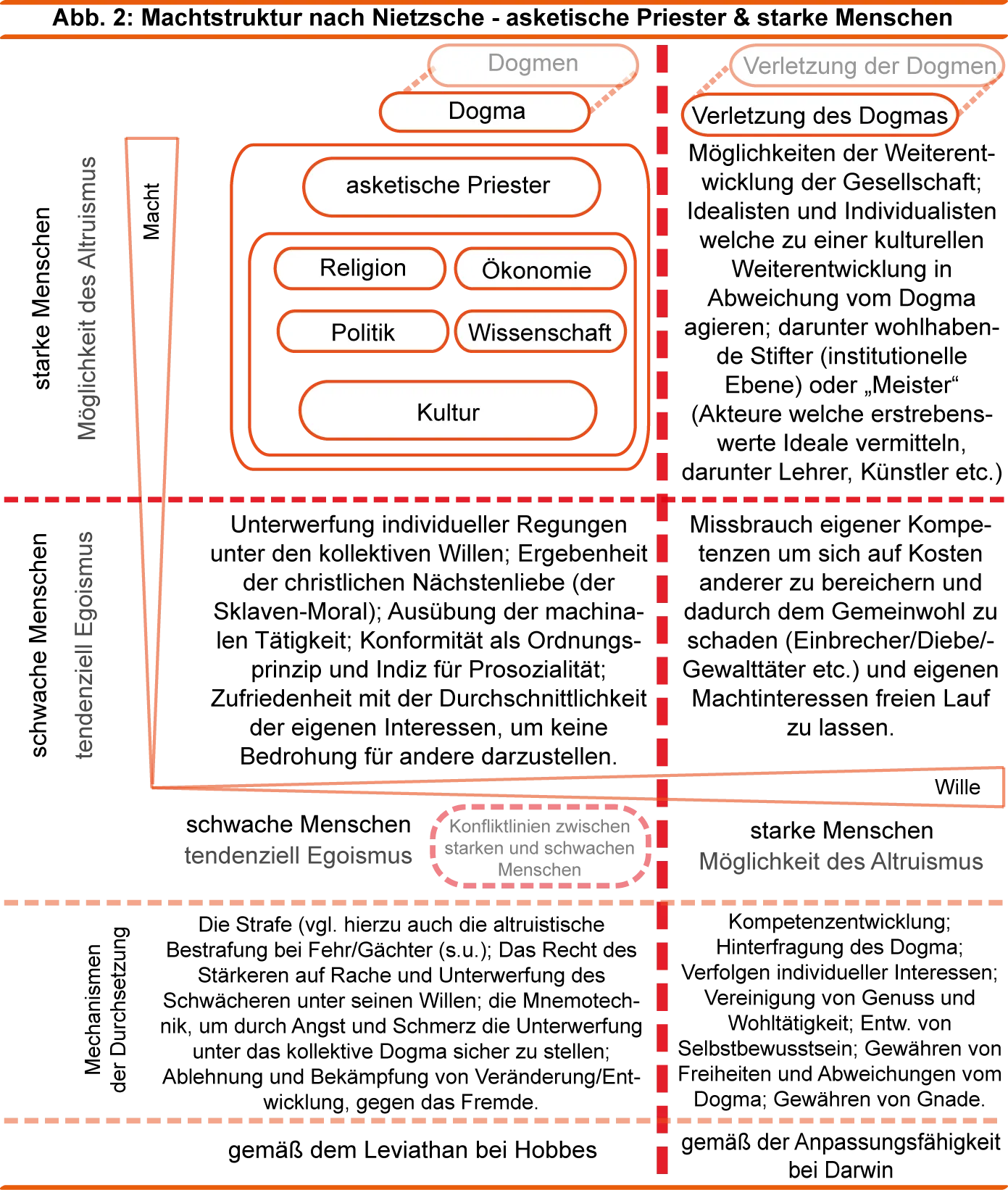
Source, Fig. 2: own depiction; notes: the red lines mark the lines of conflict between strong and weak human beings. The horizontal line of conflict marks hierarchical differences on the basis of power and influence, as found for example in political parties, religious offices, company departments, scientific renown and cultural prominence. Thus the employee has to subordinate themselves to the head of department, and the regional politician to the state minister. The vertical line of conflict distinguishes here specifically between the deviation from the dogma of the mass, and can, through a sense of responsibility and a cultural maturity, contribute to a considerable increase in welfare, or, in an immature human being, lead to the abuse of power and the assertion of their interests, and through raw violence contribute to a harming of overall welfare. A limited legitimation of the Leviathan is thereby present. Nonetheless, this permanent suppression of too great changes in society inhibits its development and thus provides for a strong dampening of overall welfare, whereby the possible positive climate is harmed by a few individual immature and power-obsessed actors. Specific explanations are to be taken from the exposition of Nietzsche (see above).
Reflection of Friedrich Nietzsche on the discourse overview
If one now takes to hand the overview14 of the years from 1990 to 2013 and lays it beside the exposition of Nietzsche (see above), several parallels quickly become clear. Thus under the ascetic priest (especially in the area of politics) one can understand the Foucauldian social worker15, who through their empathetic16 professions of loving-kindness wishes to uphold the preservation of their dogma17, their political party or religious grouping, mostly through an existing generalised trust18 and through the building of social capital19 in associations and charities20 as well as religious communities. Precisely for this reason a particular helpfulness can be found among weak human beings21 (according to Nietzsche, see above), as a kind of compensatory behaviour for the establishment of a social security, freed as far as possible from greater changes and development, in order to preserve the established order-structure, their slave morality. Indeed, their (Christian) loving-kindness towards the collective forbids them, as a sheep of the herd, to effect real changes22 and development – which should not suggest the fallacy of a generally violent enforcement of changes. However, in this view one must also take into account different levels of ascetic priests, since not only the topmost politicians count as ascetic priests of politics! Thus the topmost politicians are the ascetic priests of their direct party comrades at state level, who in turn are the ascetic priests of their party comrades at regional level, and so on, down to the local politicians as ascetic priests of the population. This by no means excludes influences of other ascetic priests from religion, economy, science and culture, but affects respectively specific areas of the personal dogma of an actor. The slave morality internalised in them expresses itself in their conception of loving-kindness and rejects reciprocity in connection with a good deed23, and demands, in case of contravention, the punishment and discrimination of these “hypocrites”, who themselves draw a personal gain (such as the favour of a loved one24) from it or even show self-destructive tendencies25 in order to pay respect to this Christian loving-kindness, their slave morality26 as a morality of suffering27, and to disparage the non-believer as a dogmatic anarchist and “dumb human being”28 – all the more so as these anarchists do not recognise them as altruists, which expresses itself in a very low voluntary participation in church institutions (2.7%), while 30.8% of actors are voluntarily engaged in non-church institutions29. And from the fact that 62%30 of the population are not active in voluntary institutions, it cannot be concluded that there would be a clear surplus of egoists, especially since these are in their main working age and, in the sense of the machinal activity in Nietzsche (see above), are occupied with providing for their livelihood. All the more so as informal volunteering has hitherto scarcely been analysed in this respect (see above: Institutional altruism in sociology). This, however, is by no means meant to stamp the influence of religion31 on helpfulness as unimportant (which Nietzsche paraphrases as a lack of knowledge of the religious connections of our cultural and historical origin (see above)), whereby it has practically no changing influence32 on our well-being; altruism, however, likewise has none, and only personal success contributes to real changes of our well-being. According to Nietzsche (2010), the great religions are in part even responsible for our developmental stagnation as a species and culture – which in large part probably also holds true.
If one is now ready to move away from this need for suffering of European religions (thus Nietzsche) and to see charity also in such situations as build upon reciprocity, this can, overall, contribute to an improvement of overall welfare33. Thus this does indeed contradict the strictly Christian-Catholic image of the human being of loving-kindness, since these acts of help can contain advantages both for the helper and for the recipient of this help (for instance someone donates, on their own initiative34, an amount X to a children’s home and feels good afterwards and has been shown gratitude); yet it cannot be denied that the improvement of the situation of the one in need of help and the personal success (see above) of the one giving help implies an improvement of welfare on both sides of the interaction. Perhaps simply through the feeling of confirmation of being needed35. The appeal, then, is obvious: to set oneself against this slave morality sketched by Nietzsche (see above) and to illuminate especially the positive aspects of overall welfare, which especially on the institutional level can contain a mutual, probably generally reciprocal advantage (cf. on this also Mauss (see below)). And with this one should generally direct the analysis towards positive aspects36 (among them feelings37) and not only try again and again to confirm what is negative and already known, and to try to declare it a condition of life – which, among other things, has led to the emergence of “positive psychology”38, as Nietzsche (see above) too generally appeals to science. And if one considers the strong human being in Nietzsche (see above) and imagines them as the founder whom Sigmund (see above) has described, then already in Nietzsche the description of an altruistic personality39 is present in outline. A self-confident40 individual character, ready to violate the dogmas of the masses and to allow development, a deviation from the norm of slave morality in order to effect and to receive something positive and thus to contribute to a real increase of overall welfare, and not, through obligated suffering (according to slave morality), to effect only a shift of prosperity, or even a lowering of welfare, should deeper-reaching disadvantages arise for the donor from their well-meant good deed which they did not take into account in the zeal of loving-kindness. Nonetheless it cannot be denied that this can also be a strategic action out of pure self-interest, whereby the strong human being in Nietzsche can also constitute an ascetic priest, who uses their competences, their empathy and their self-confidence in order to control other, weak human beings with fear41, suffering and violence (mnemonics/slave morality) and to present these to them as a necessity of the “civilised order”, or to act in the same function as a Foucauldian social worker. And precisely this connection makes altruism, or specifically the personality of the possible altruist, one of the most important areas of analysis for leadership42. Thus it shows that Nietzsche already, long ago, provided a very good assessment of societal power structures and thereby provided the framing of socially relevant factors of influence, and today has by no means lost validity and can be inspiring for altruism research, especially in relation to institutional altruism (see above). The constant contradiction44 of the philosopher/scientist with themselves can also, in the meantime, be empirically demonstrated and is a further indication of this inhibition through slave morality (see above), whereby some reject the moralisation of this debate. Thus, on the one hand, prosocial behaviour45 is understood as a pronounced form of prosocial behaviour (which again suggests the altruistic personality of the strong human being), while others here more strongly wish to formulate an ethics, as Thomas Nagel now does in the following with increasing emphasis, one of the strongest advocates of altruism today. A short overview of the power structures in Nietzsche is depicted in Figure 2 (see above), which at the same time provides a first framework of the possibility of altruism, to which especially Thomas Nagel devotes himself in the following.
Endnotes
- In accordance with contemporary spelling!
- Mose 3 [URL: http://www.bibelstudium.de/bibelpopup.php?ref=1/3/0, 2014.02.24: 13:24Uhr]
- Here one may recall the working customer of G. Günter Voß as well as his labour-power entrepreneur (Pongratz/Voß 1998, 2003).
- „Man spürt, daß es keinen besseren Weg gibt, Menschen zur Arbeit zu bringen, als dadurch, daß man ihnen die Gewißheit gibt, ihr Leben lang loyal bezahlt zu werden für die Arbeit, die sie loyal ausgeführt haben, und zwar sowohl für andere wie für sich selbst.“ (Mauss 1990: 174)
- Formulated, in accordance with contemporary spelling, as machinale Tätigkeit!
- Recall at this point the displeasure of Martin Luther in Europe on being confronted with the indulgence slips of the Christian Church.
- According to Nietzsche (2010: 147ff), the philosopher must gather experiences in order really to become a philosopher/scholar, for without these they fail to recognise essential components of societal reality and, strictly speaking, continue to move in the dark.
- In the original: „Es ist in Sonderheit der Anblick jener Mischmach-Philosophen, die sich ‚Wirklichkeits-Philosophen‘ oder ‚Positivisten‘ nennen, welcher ein gefährliches Misstrauen in die Seele eines jungen, ehrgeizigen Gelehrten zu werfen im Stande ist: das sind ja besten Falls selbst Gelehrte und Spezialisten, man greift es mit Händen! — das sind ja allesammt Überwundene und unter die Botmässigkeit der Wissenschaft Zurückgebrachte, welche irgendwann einmal ‚mehr‘ von sich gewollt haben, […]“ (Nietzsche 2010: 131)
- For understanding, refer here to the term and concept of the habitus in Pierre Bourdieu (1976, 1985, 1987a, 1987b, 1992), as the internalised cultural conventions in the form of norms and values which decisively influence our perception and our resulting action.
- Even if this connection to the religious has long since escaped them (Nietzsche 2010: 154).
- „Sprach-Verwandtschaft“ (Nietzsche 2010: 34)
- In the English original: „Consequently, green consumption may be stimulated by adding emotional experiences of the ‚nature-feelings‘ kind to the benefit perception of environmental products.“ (Hartmann/Apaolaza-Ibáñez 2008: 833); „The case of the green brand of the three analyzed energy brands illustrates how a brand, initially not perceived as environmentally friendly and not associated with nature, can be transformed to evoke virtual nature experiences in most consumers: by applying persuasive communication strategies, that is, through the use of emotional conditioning (Aaker & Stayman, 1992; Kim et al., 1998; Kroeber-Riel, 1984).“ (ibid.: 833f); „[…] Levi and Kocher‘s (1999) findings: people may eventually downgrade the value of local natural environments because of their experiences with virtual nature.“ (ibid.: 834); this, however, describes the manipulation of people, which has little to do with a real development of consciousness of the human being and results in undesired side effects, like a bureaucracy that rigidly follows its self-set guidelines and as a rule adapts to new circumstances only with considerable effort, thereby causing immense damage to overall welfare! Cf. on this especially Nietzsche’s slave morality and set it against emotional conditioning, as an instrument of practical application.
- Cf. on this also Brown/Ferris (2007): „Individuals with greater stocks of networks based social capital tend to give more to religious causes and to give more to secular causes. Individuals with higher levels of norm-based social capital volunteer more and give more to secular causes.“ (96); especially the strong turning to religious causes among actors with network-based social capital speaks for the herd/follower structures, based on social pressure/collective compulsions, in Nietzsche (see below); „[…], the importance of norm-based social capital is significant in the two instances that are not religion specific.“ (96f); „[…] a belief in the civic life of a community in terms of trusting others is important in encouraging gifts of money for secular causes and volunteering time. […], our results indicate that the estimated direct impact of education is substantially smaller when social capital is taken into account.“ (ibid.: 97).
- Here let it be noted that the discourse overview contains further background information on the following footnotes and that this depiction listed here serves merely as a search aid in the discourse overview. Here, especially in the digital version of the work, one can navigate very quickly with the “search” function [ctrl + f or cmd + f]. More detailed information is to be taken from the source citations themselves.
- Margolin (1997 in Floersch 1999) 1999
- Epley/Caruso/Bazerman 2006
- Reyes 2011
- Sargeant/Lee 2004: 198; Irwin/McGrimmon/Simpson 2008
- Whereby this, according to Yeung (2004), is very conducive to the emergence of voluntary engagement.
- Leal 2006
- Carlo et al. 1991
- Cowen 1993: 224
- Runciman 2004: 7, 12
- Newman/Cain 2014
- Kierkgegaard 1980 in Hampton 1993: 135; Cowley/Paterson/Williams 2004
- Piff et al. 2010
- de Hooge et al. 2011
- Saroglou/Yzerbyt/Kaschten 2011: 490ff
- Yeung 2004: 409
- Yeung 2004: 418
- Brown/Ferris 2007
- Meulemann 2010
- Weinstein/Ryan 2010
- Nelson/Norton 2005
- Rosenberrg 1985 in Simmons 1991: 10
- Goffman 1961: 10ff, 27f, 41
- Simmons 1991: 9
- Piliavin 2008: 221
- varese/yaish 2005
- Underwood 2005
- Heger 2010; Rölle 2010
- Sosik/Jung/Dinger 2009
- Mills 1962
- Feiler/Tost/Grant 2012
- Batson et al. 1997
Quellen
- Aaker, D. A. und D. M. Stayman, 1992: Implementing the concept of transformational advertising. In: Psychology & Marketing, 9: 237-253. In: Hartmann, Patrick und Vanessa Apao-laza-Ibáñez, 2008: Virtual Nature Experiences as Emotional Benefits in Green Product Consumption: The Moderating Role of Environmental Attitudes. In: Environment and Behavior, 40(6): 834. DOI: 10.1177/0013916507309870.
- Bourdieu, Pierre, 1976: Die Illusion der Regel. In: Ders. (Hrsg.): Entwurf einer Theorie der Praxis. Frankfurt/M: 203-228.
- Bourdieu, Pierre, 1985: Sozialer Raum und Klassen. Lecon sur la Lecon. Zwei Vorlesungen. Frankfurt/M.: Suhrkamp Verlag.
- Bourdieu, Pierre, 1987a: Strukturen, Habitusformen, Praktiken. In: Ders. (Hrsg.): Sozialer Sinn. Frankfurt/M.: Suhrkamp Verlag: 97-121.
- Bourdieu, Pierre, 1987b: Die feinen Unterschiede. Kritik der gesellschaftlichen Urteilskraft. Frankfurt/M.: Suhrkamp Verlag.
- Bourdieu, Pierre, 1992: Die verborgenen Mechanismen der Macht. Hamburg.
- Bourdieu, Pierre, 1992: Ökonomisches Kapital – Kulturelles Kapital – Soziales Kapital. In: Ders. (Hrsg.): Die verborgenen Mechanismen der Macht. Hamburg: 49-79.
- Brown, Eleanor und James M. Ferris, 2007: Social Capital and Philanthropy: An Analysis of the Impact of Social Capital on Individual Giving and Volunteering. In: Nonprofit and Voluntary Sector Quarterly, 36(1): 85-99. DOI: 10.1177/0899764006293178.
- Batson, C. Daniel, Marina P. Polycarpou, Eddie Harmon-Jones, Heidi J. Imhoff, Erin C. Mitche- ner, Lori L. Bednar, Tricia R. Klein und Lori Highberger, 1997: Empathy and Attitudes: Can Feeling for a Member of a Stigmatized Group Improve Feelings Toward the Group? In: Journal of Personality and Social Psychology, 72(1): 105-118.
- Carlo, Gustavo, Nancy Eisenberg, Debra Troyer, Galen Switzer und Anna L. Speer, 1991: The Altruistic Personality: In What Contexts Is It Apparent? In: Journal of Personality and Social Psychology, 61(3): 450-458.
- Cowen, Tyler, 1993: ALTRUISM AND THE ARGUMENT FROM OFFSETTING TRANSFERS. In: Social Philosophy & Policy, 10(1): 225-245.
- Cowley, Esther Tumama, Janis Paterson und Maynard Williams, 2004: Traditional Gift Giving Among Pacific Families in New Zealand. In: Journal of Family and Economic Issues, 25(3): 431-444.
- de Hooge, Ilona E., Rob M. A. Nelissen, Seger M. Breugelmans und Marcel Zeelenberg, 2011: What Is Moral About Guilt? Acting “Prosocially“ at the Disadvantage of Others. In: Journal of Personality and Social Psychology, 100(3): 462-473. DOI: 10.1037/a0021459.
- Epley, Nicholas, Eugene M. Caruso und Max H. Bazerman, 2006: When Perspective Taking Increases Taking: Reactive Egoism in Social Interaction. In: Journal of Personality and Social Psychology, 91(5): 872-889. DOI: 10.1037/0022-3514.91.5.872.
- Feiler, Daniel C., Leigh P. Tost und Adam M. Grant, 2012: Mixed reasons, missed givings: The costs of blending egoistic and altruistic reasons in donation requests. In: Journal of Experimental Social Psychology, 48(6): 1322-1328. DOI: 10.1016/j.jesp.2012.05.014.
- Floersch, Jerry, 1999: Under the Cover of Kindness: The Invention of Social Work by Lesli Margolin. In: American Journal of Sociology, 104(4): 1216-1218. URL: http://www.jstor.org/ stable/10.1086/210150.
- Goffman, Erving, 1961: Encounters. two studies in the sociology of interaction. Indianapolis, New York: THE BOBBS-MERRILL COMPANY, INC.: 7-81.
- Haase, Julia, 2016(02. Dez.): Das macht Sex mit den Gehirnen von Frauen. In: Welt (online) [URL: https://www.welt.de/kmpkt/article159918360/Das-macht-Sex-mit-den-Gehirnen-von- Frauen.html, 2016.12.05: 14:14Uhr].
- Hampton, Jean, 1993: SELFLESSNESS AND THE LOSS OF SELF. In: Social Philosophy & Policy, 10(1): 135-165.
- Hartmann, Patrick und Vanessa Apaolaza-Ibáñez, 2008: Virtual Nature Experiences as Emotional Benefits in Green Product Consumption: The Moderating Role of Environmental Attitudes. In: Environment and Behavior, 40(6): 818-842. DOI: 10.1177/0013916507309870.
- Heger, Nora, 2010: Die Entwicklung der Sicherheitsgesellschaft am Beispiel der Video- überwachung am Wiener Schwedenplatz. In: A. Groenemeyer (Hrsg.): Wege der Sicherheitsgesellschaft. Wiesbaden: VS Verlag für Sozialwissenschaften: 343-357.
- Hillmann, Karl-Heinz und Günter Hartfiel, 2007: Wörterbuch der Soziologie. (5. Aufl.) Stuttgart: Kröner.
- Irwin, Kyle, Tucker McGrimmon und Brent Simpson, 2008: Sympathy and Social Order. In: Social Psychology Quarterly, 71(4): 379-397. URL: http://www.jstor.org/stable/27644322.
- Kierkegaard, Soren, 1989: The Sickness Unto Death. (trans. Alastair Hannay) Harmondsworth: Penguin. S. 62-63. In: Hampton, Jean, 1993: SELFLESSNESS AND THE LOSS OF SELF. In: Social Philosophy & Policy, 10(1): 135.
- Kim, J., J.-S. Lim und M. Bhargava, 1998: The role of affect in attitude formation: A classical conditioning approach. In: Journal of the Academy of Marketing Science, 26: 143-152. In: Hartmann, Patrick und Vanessa Apaolaza-Ibáñez, 2008: Virtual Nature Experiences as Emotional Benefits in Green Product Consumption: The Moderating Role of Environmental Attitudes. In: Environment and Behavior, 40(6): 834. DOI: 10.1177/0013916507309870.
- Kroeber-Riel, W., 1984: Emotional product differentiation by classical conditioning (with consequences for the „low-involvement hierarchy“). In: Advances in Consumer Research, 11: 538-543. In: Hartmann, Patrick und Vanessa Apaolaza-Ibáñez, 2008: Virtual Nature Experiences as Emotional Benefits in Green Product Consumption: The Mo- derating Role of Environmental Attitudes. In: Environment and Behavior, 40(6): 834. DOI: 10.1177/0013916507309870.
- Leal, Fernando, 2006: On the Ethics and Economics of Organized Citizenship. In: Organization, 13(4): 569-587. DOI: 10.1177/1350508406065106.
- Levi, D. und S. Kocher, 1999: Virtual nature. The future effects of information technology on our relationship to nature. In: Environment and Behavior, 31: 203-226. In: Hartmann, Patrick und Vanessa Apaolaza-Ibáñez, 2008: Virtual Nature Experiences as Emotional Benefits in Green Product Consumption: The Moderating Role of Environmental Attitudes. In: Environment and Behavior, 40(6): 834. DOI: 10.1177/0013916507309870.
- Luther, D. Martin, 1938: Die Bibel oder die ganze heilige Schrift des Alten u. Neuen Testaments nach der deutschen Übersetzung D. Martin Luthers. Stuttgart: privilegierte Württembergische Bibelanstalt.
- Margolin, Leslie, 1997: Under the Cover of Kindness: The Invention of Social Work. Charlottesville: University Press of Virginia. In: Floersch, Jerry, 1999: Under the Cover of Kindness: The Invention of Social Work by Lesli Margolin. In: American Journal of Sociology, 104(4): 1216-1218. URL: http://www.jstor.org/stable/10.1086/210150.
- Mauss, Marcel, 1990: Die Gabe. Form und Funktion des Austauschs in archaischen Gesellschaften. (1. Aufl.) Frankfurt/M.: Suhrkamp.
- Meulemann, Heiner, 2010: Self-Concern, Self-Transcendence, and Well-Being. In: European Sociological Review, 26(4): 385-399. DOI: 10.1093/esr/jcp027.
- Mills, C. Wright, 1962: Die amerikaniche Elite. Gesellschaft und Macht in den Vereinigten Staaten. Hamburg: Holsten-Verlag Schenke & Haß. – im engl. Original von 1956: „The Power Elite“.
- Nelson, Leif D. und Michael I. Norton, 2005: From student to superhero: Situational primes shape future helping. In: Journal of Experimental Social Psychology, 41(4): 423-430. DOI: 10.1016/j.jesp.2004.08.003.
- Newman, George E. und Daylian M. Cain, 2014: Tainted Altruism: When Doing Good Is Evaluated as Worse Than Doing No Good at All. In: Psychological Science: 1-8. DOI: 10.1177/0956797613504785.
- Nietzsche, Friedrich, 2010: Jenseits von Gut und Böse. und Zur Genealogie der Moral. In: Colli, Giorgio und Mazzino Montinari (Hrsg.): Friedrich Nietsche. Jenseits von Gut und Böse. Zur Genealogie der Moral. Kritische Studienausgabe. (11. Aufl.) München: Deutscher Taschenbuchverlag: 9-243, 245-412.
- Piff, Paul K., Michael W. Kraus, Stéphane Côté, Bonnie Hayden Cheng und Dacher Keltner, 2010: Having Less, Giving More: The Influence of Social Class on Prosocial Behavior. In: Journal of Personality and Social Psychology, 99(5): 771-784. DOI: 10.1037/a0020092.
- Piliavin, Jane Allyn und Hong-Wen Charng 1990: Altruism: A Review of Recent Theory and Research. In: Annual Review of Sociology, 16(1): 27-65.
- Piliavin, Jane Allyn und P. L. Callero, 1990: Giving the Gift of Life to Unnamed Strangers. Baltimore: Johns Hopkins University Press. In: Piliavin, Jane Allyn und Hong-Wen Charng 1990: Altruism: A Review of Recent Theory and Research. In: Annual Review of Sociology, 16(1): 43.
- Piliavin, Jane Allyn, 1997: The Heart of Altruism: Perceptions of a Common Humanity by Kristen Renwick Monroe. In: American Journal of Sociology, 103(2): 495-497. URL: http:// www.jstor.org/stable/10.1086/231231.
- Piliavin, Jane Allyn, 2009: Altruism and Helping: The Evolution of a Field: The 2008 Cooley-Mead Presentation. In: Social Psychology Quarterly, 72(3): 209-225. URL: http://www. jstor.org/stable/25593924.
- Pongratz, Hans J., und G. Günter Voß, 1998: Der Arbeitskraftunternehmer. Eine neue Grundform der Ware Arbeitskraft? In: Kölner Zeitschrift für Soziologie und Sozialpsychologie, 50(1): 131-158.
- Pongratz, Hans J., und G. Günter Voß, 2003: Arbeitskraftunternehmer. Erwerbsorientierungen in entgrenzten Arbeitsformen. Berlin: edition sigma.
- Reyes, Antonio, 2011: Strategies of legitimization in political discourse: From words to actions. In: Discourse & Society, 22(6): 781-807. DOI: 10.1177/0957926511419927.
- Rosenberg, Morris, 1981: Occupations and Values. New York: Arno Press. In: Simmons, Roberta G., 1991: Presidential Address on Altruism and Sociology. In: The Sociological Quarterly, 32(1): 10.
- Rölle, Daniel, 2010: Unsicherheitsgefühle, Mediennutzung und Vertrauen in Institutionen. Empirisch belastbare Zusammenhänge oder Messartefakte? In: A. Groenemeyer (Hrsg.): Wege der Sicherheitsgesellschaft. Wiesbaden: VS Verlag für Sozialwissenschaften: 89-111.
- Runciman, W. G., 2004: The Diffusion of Christianity in the Third Century AD as a Case-Study in the Theory of Cultural Selection. In: European Journal of Sociology / Archives Européennes de Sociologie, 45(1): 3-21. DOI: 10.1017/S0003975604001365.
- Sargeant, Adrian und Stephen Lee, 2004: Donor Trust and Relationship Commitment in the U.K. Charity Sector: The Impact on Behavior. In: Nonprofit and Voluntary Sector Quarterly, 33(2): 185-202. DOI: 10.1177/0899764004263321.
- Saroglou, Vassilis, Vincent Yzerbyt und Cécile Kaschten, 2011: Meta-stereotypes of Groups with Opposite Religious Views: Believers and Non-Believers. In: Journal of Community & Applied Social Psychology, 21(6): 484-498. DOI: 10.1002/casp.1123.
- Simmons, Roberta G., 1991: Presidential Address on Altruism and Sociology. In: The Sociological Quarterly, 32(1): 1-22. URL: http://www.jstor.org/stable/4121438.
- Sosik, John J., Dongil Jung und Sandi L. Dinger, 2009: Values in Authentic Action: Examining the Roots and Rewards of Altruistic Leadership. In: Group & Organization Management, 34(4): 395-431. DOI: 10.1177/1059601108329212.
- Underwood, Lynn G., 2005: Interviews with Trappist Monks as a Contribution to Research Methodology in the Investigation of Compassionate Love. In: Journal for the Theory of Social Behaviour, 35(3): 285-302.
- varese, federico und meir yaish, 2005: resolute heroes: the rescue of jews during the nazi occupation of europe. In: European Journal of Sociology / Archives Européennes de Sociologie, 46(1): 153-168. DOI: 10.1017/S0003975605000068.
- Weinstein, Netta und Richard M. Ryan, 2010: When Helping Helps: Autonomous Motivation for Prosocial Behavior and Its Influence on Well-Being for the Helper and Recipient. In: Journal of Personality and Social Psychology, 98(2): 222-244. DOI: 10.1037/a0016984.
- Yeung, Anne Birgitta, 2004: An Intricate Triangle– Religiosity, Volunteering, and Social Capital: The European Perspective, the Case of Finland. In: Nonprofit and Voluntary Sector Quarterly, 33(3): 401-422. DOI: 10.1177/0899764004265426.
Frequently asked questions
Was Nietzsche an egoist?
No – that is a widespread misunderstanding. Nietzsche criticises a particular form of enforced self-sacrifice (“slave morality”), not the good in the human being as such. In him a genuine, voluntary altruism is very much laid out.
What is “slave morality” in Nietzsche?
A morality that declares weakness, subordination and suffering to be virtue and fights every deviation of the “herd”. It protects existing power structures by making strength and independence morally suspect.
Who are the “ascetic priests”?
Nietzsche’s image for the bearers and beneficiaries of this morality – not only religious leaders, but also political, economic, scientific and cultural ones. They bind the mass to a dogma and punish the deviant.
Is there genuine altruism in Nietzsche?
Yes. His “strong human being” can very well act altruistically – but out of free decision and strength, not out of duty or fear. That is precisely what distinguishes them from the enforced selflessness of slave morality.
What characterises the “strong human being”?
Not power over others, but power over oneself: self-overcoming, fidelity to principles, fairness and the readiness to take responsibility and to let others go their way. Strength here expressly does not mean ruthlessness.
Sources
- Tobias O. R. Alke: Ausgewählte Perspektiven des Altruismus. Eine interdisziplinäre Anregung der Soziologie und ihr Gewicht im Altruismusdiskurs von 1990 bis 2013 im Überblick. Kyborg Institut und Verlag, 2017. ISBN 978-3-96104-027-8. Eintrag Deutsche Nationalbibliothek
- Friedrich Nietzsche: Jenseits von Gut und Böse (1886) und Zur Genealogie der Moral (1887), zitiert nach der Kritischen Studienausgabe (Hrsg. Colli/Montinari). Volltext „Zur Genealogie der Moral” (Projekt Gutenberg)
- Thomas Nagel: The Possibility of Altruism (1970; dt. „Die Möglichkeit des Altruismus”) – zur philosophischen Begründung des Altruismus.
- Karl-Heinz Hillmann / Günter Hartfiel: Wörterbuch der Soziologie. 5. Aufl., Kröner, Stuttgart 2007 – zum Stichwort „Altruismus” (Nietzsche-Bezug).