The Development of the Altruism Discourse
Autor: Tobias O. R. Alke
Standpoint · in depth. This text is an excerpt from the scholarly work Ausgewählte Perspektiven des Altruismus (Selected Perspectives on Altruism, 2017) by Tobias O. R. Alke. It examines the altruism discourse quantitatively (1990–2013) and is the deepening of the lexicon pillar Altruism. It is a chapter of a larger work – references to the “introduction”, the “following chapter” or “Appendix A/B” relate to the original.
Translator’s note: source citations and the bibliography are retained in the original; German column and row labels within the data tables have been translated, the figures left unchanged.
This section traces the development of the scholarly discourse on altruism and gives an overview of its central focal points in the participating disciplines.
Author: Tobias O. R. Alke
In the present section, no detailed presentation of all the concepts and reflections on altruism is to find a place, but rather an overview of the central focal points of the debate. The central discussion will first contribute in the subsequent chapter on the selected perspectives on altruism and their contribution to a revival of the altruism debate in sociology, which is increasingly dominated by models from social psychology and, more and more, economics. However, in order to specify the necessary models, a delimitation of the existing texts must first be carried out, which was made possible here with the help of online-accessible databases. The exact working steps are to be taken from Appendix A/B. The delimitation of the literature was preceded by a rough working-through of the following texts: Baurmann (1990), Bierhoff (2002a/b), de Waal (2008), Fehr/Gächter (2002), Hillmann et al. (2007: 23), Mauss (1990), Nagel (2005), Ockenfels (1999) and Tomasello (2010). The delimitation of the period back to 1990 is chosen, on the one hand, on the basis of Piliavin/Charng (1990), who provided an interdisciplinary overview of the theoretical and empirical state of research on altruism up to 1990, among others for sociology as well. Furthermore, at the time of the survey (Appendix A) the starting date of 1990 was chosen, since up to then no cross-database availability of the search terms listed below after 1990 was possible via the primary database (HEIDI – Universität Heidelberg).
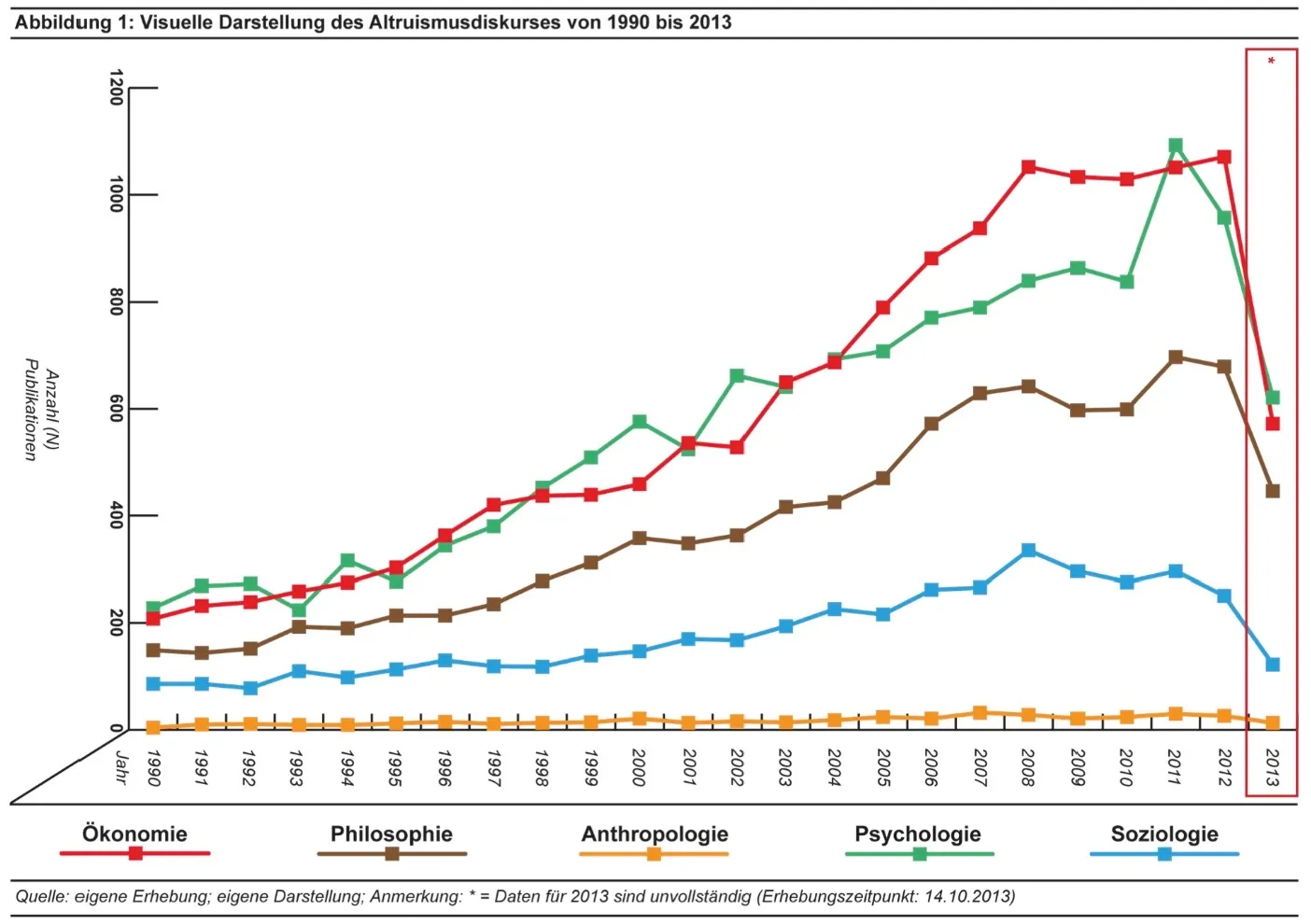
Sociology takes on a comparatively subordinate role within the discussions of altruism, although through Auguste Comte (its name-giver, both of altruism and of sociology itself (see below)) it is the origin of the term. Bound up with this is a formative effect through the understanding of loving-kindness, a self-sacrifice and consideration for others as Comte demands. In the present section, the disciplines already named in the introduction – philosophy, anthropology, (social) psychology, economics and sociology – are to be presented introductorily in figures (Table 1) and visually (Fig. 1), in order to sketch their respective weight in the debate on altruism.
Table 1: Overview of the publications of the altruism discourse from 1990 to 2013 in figures
| Year | Total | 1990 | 1991 | 1992 | 1993 | 1994 | 1995 | 1996 | 1997 | 1998 | 1999 | 2000 | 2001 | 2002 | 2003 | 2004 | 2005 | 2006 | 2007 | 2008 | 2009 | 2010 | 2011 | 2012 | 2013* |
| Anthropology | 409 0,30% | 4 0,14% | 10 0,36% | 11 0,37% | 9 0,30% | 9 0,27% | 12 0,35% | 15 0,40% | 11 0,26% | 13 0,28% | 14 0,29% | 21 0,40% | 13 0,25% | 16 0,29% | 14 0,23% | 18 0,28% | 24 0,35% | 21 0,27% | 32 0,40% | 28 0,34% | 21 0,26% | 24 0,30% | 30 0,33% | 26 0,28% | 13 0,25% |
| Philosophy | 9322 6,90% | 149 5,15% | 144 5,12% | 152 5,10% | 193 6,35% | 190 5,61% | 214 6,33% | 214 5,71% | 235 5,45% | 278 6,04% | 312 6,42% | 358 6,81% | 348 6,68% | 363 6,47% | 416 6,98% | 425 6,53% | 470 6,82% | 572 7,29% | 629 7,83% | 642 7,79% | 597 7,32% | 599 7,47% | 697 7,64% | 679 7,44% | 446 8,64% |
| Economics | 14452 10,69% | 208 7,19% | 232 8,24% | 239 8,01% | 259 8,83% | 275 8,13% | 303 8,96% | 363 9,69% | 420 9,74% | 437 9,49% | 439 9,03% | 459 8,73% | 536 10,29% | 528 9,42% | 650 10,90% | 687 10,55% | 790 11,47% | 882 11,24% | 937 11,67% | 1052 12,77% | 1033 12,66% | 1029 12,82% | 1051 11,52% | 1071 11,73% | 572 11,09% |
| Psychology | 13850 10,25% | 228 7,88% | 269 9,56% | 273 9,15% | 224 7,37% | 316 9,34% | 277 8,19% | 344 9,19% | 380 8,81% | 452 9,82% | 509 10,47% | 576 10,95% | 524 10,06% | 662 11,81% | 641 10,75% | 693 10,65% | 708 10,28% | 771 9,82% | 790 9,84% | 840 10,20% | 864 10,59% | 838 10,44% | 1093 11,98% | 957 10,48% | 621 12,03% |
| Sociology | 4302 3,18% | 86 2,97% | 86 3,06% | 78 2,61% | 110 3,62% | 98 2,90% | 113 3,34% | 130 3,47% | 119 2,76% | 118 2,56% | 139 2,86% | 147 2,80% | 170 3,26% | 168 3,00% | 194 3,25% | 226 3,47% | 216 3,14% | 262 3,34% | 266 3,31% | 335 4,07% | 296 3,63% | 276 3,44% | 296 3,25% | 251 2,75% | 122 2,36% |
| Share of the 5 disciplines in total | 31,32% | 23,34% | 26,33% | 25,24% | 26,17% | 26,24% | 27,18% | 28,46% | 27,01% | 28,19% | 29,06% | 29,68% | 30,56% | 30,98% | 32,13% | 31,48% | 32,05% | 31,95% | 33,04% | 35,17% | 34,45% | 34,47% | 34,72% | 32,68% | 34,38% |
| Discourse in total | 135163 | 2892 | 2814 | 2983 | 3038 | 3381 | 3381 | 3745 | 4313 | 4604 | 4862 | 5259 | 5207 | 5607 | 5961 | 6509 | 6889 | 7850 | 8032 | 8238 | 8159 | 8024 | 9121 | 9131 | 5160 |
Source: own survey via HEIDI (see below) of 21 November 2013; own depiction; notes: figures in N = case number; search word of the survey “altruism”; for technical reasons this depiction can only be counted as a sample, not, however, as a representative overall view; * = the 2013 row is incomplete owing to the time of the survey.
There follows a short guide to the substantive focal points of the different decades. For the period from 1990 to 1999 there are (N =) 78 (sample-wise) recorded literature entries, for the period from 2000 to 2009 there are (N =) 160 (sample-wise) recorded literature entries, and for the period from 2010 to 2013 there are (N =) 91 (sample-wise) recorded literature entries. Substantive notes relate to a search restricted to the discipline of sociology. Owing to the difficult delimitation of the substantive questions of sociology, especially from psychology, the databases taken into account here assigned a very high proportion of (social-) psychological writings to sociology as well. This circumstance I evaluate, within the aspiration of a revival of the altruism discourse in sociology, as positive, since (social) psychology, in contrast to sociology, has proven an extremely high research engagement and can clear up many open questions and doubts of sociology, provided sociology recognises the achievements of (social) psychology.
As Fig. 1 makes clear, economics, as in many other areas, also takes on a dominant role in the altruism discourse. In relation to the theme of altruism it has even overtaken psychology, which, with the exception of the year 2011, has strongly declined. Philosophy has indeed also developed well, but on the whole it is slackening, while sociology, after its all-time high of 2008, decreases relatively constantly. If one takes into account the then worldwide banking crisis, which still shows an effect today (July 2015), and the associated mass expropriations of homeowners on the basis of “bad” loans on the part of their lenders, which in 2013 were again admitted1 to international trade, these have contributed to international feelings of scarcity and thereby strongly curtailed the sense of freedom worldwide. This leads, according to the general understanding of sociology, to a reduction of its justification/basis of existence, as the introduction to sociology further below in the text shows. Thus the banking crisis of 2008 can also be regarded directly as an endangerment of sociology as a discipline itself, and seems to have brought economics considerable successes, all the more so as only the latter records, throughout 2011, a steady growth of its annual publications. The altruism discourse in sociology thereby takes place predominantly in (social) psychological journals, while only a fraction appears in genuinely sociological journals. This speaks, on the one hand, for the interdisciplinary significance of the altruism theme, but also points to an alarming decline in the participation in the discussion on the part of sociology.
Thus Table 2 shows an overview of all the journals which, in the preceding overview, contained articles on altruism.
Table 2: Journals for sociological altruism publications in overview.
Source: own survey (from HEIDI 2013); own depiction
Here it becomes clear that above all social-psychological journals dominate the discourse in the social context. Among the first 5 journals belong the “Journal of Personality and Social Psychology”, the “European Journal of Social Psychology”, “Environment and Behavior”, the “Journal of Applied Social Psychology” and the “Journal of Experimental Social Psychology”. Only from rank six onwards do more strongly sociological specialist journals follow, “Nonprofit and Voluntary Sector Quarterly” or “Social Philosophy & Policy”, whereby the strictly sociological specialist journals such as the “American Journal of Sociology” follow only from rank 17, and all the tail-enders of the overview are formed by sociological specialist journals. If, with one’s own contribution on altruism, a term with its roots in sociology, one wishes to take part in as broad a discourse as possible, it seems more sensible to position oneself as far as possible in the Journal of Personality and Social Psychology and to decide against subject-specific sociology journals, since the thematic engagement of the sociological specialist journals is simply minimal. Even in one of its own subject-specific themes, sociology is not in a position to conduct the greater part of the discourse in its own specialist journals, quite apart from the fact that various empirical evidence on social connections in the context of altruism does not even stem from sociologists. Before I now turn to the substantive overview of the three decades, I would like to go into the distribution of the debate into empirical and theoretical works from the depiction in Table 3.
Table 3: Proportion of empirical and theoretical contents in the present publications.
| 1990-1999 | 2000-2009 | 2010-2013 | Total | |
| empirical | 4 | 109 | 68 | 181 |
| theoretical | 42 | 30 | 10 | 82 |
| review / other | 35 | 3 | 1 | 39 |
| multiple assignment | 5 | 3 | 8 | 16 |
| N | 78 | 160 | 91 | 329 |
| N o (without digital document) | – | 19 | 16 | 35 |
Source: own survey (HEIDI 2013); own depiction
Thus it becomes evident that a clear surplus of empirical works is present in this area, which in itself is nothing unusual. However, the theoretical engagement with altruism in the strongly sociological context decreases markedly, while the ratio has developed much more strongly in favour of the empirical, which Comte (see above) regards critically and which speaks for the generally known decline in the basic research of sociology (which is presumably also a side effect of the new technical possibilities of our time, since one can come by extensive surveys far more cheaply and quickly and thus conduct large experiments more efficiently than before). However, it seems to me questionable if one hardly engages theoretically with altruism any more, which in my view is also mirrored in the strong dominance of economic concepts in sociology, and even models such as altruistic punishment find considerable recognition within it, as an altruistic model (see on this Fehr/Gächter (see below))! Yet let attention also be drawn to the figures on the multiple assignments, since some works engage with the theme of altruism both theoretically and empirically, while for some works not even the abstracts were recorded in the databases, which again speaks for the incompleteness of the databases. If one now takes the overall proportion of sociology in per cent from Table 1 and adds the sample of texts in Table 2 (N=282), a total of 132 works from primarily (social) psychological journals2 can be struck out as not immediately social-scientific works, whereby 46.81%3 of the works must be deducted. If this ratio also corresponds to the search results from the overall overview, sociology would not make up a 3.18% share of the altruism discourse, but only 1.69%4. The overview that now follows will provide a sketch of the substantive focal points of the three decades, in order subsequently to name them concretely, thematically arranged. Thus an overview of the thematic focal points of the three decades should be possible, and the substantive differentiation should allow a better discussion, as well as a German-language substantive overview of the altruism works of the last 23 years.
Methodological procedure of the literature delimitation
In order first to obtain an overview of the existing literature, the databases listed in Appendix A were used with the search terms “Altruismus” and, in English, “altruism”. The period for the literature to be taken into account amounted, as far as possible, to the year 1989 and higher, since in 1990 an overview of the theory discourse on altruism by Piliavin was published in “Altruism: A Review of Recent Theory and Research”. All the literature entries were imported automatically via EndNote X6 into a locally created and backed-up database, and, as far as possible, including the digital document, mostly in the form of a PDF. Owing to the budget problems of the US government in 2013, some servers were unreachable at the time of the recording of the digital documents. This limitation, however, affects only a small percentage (approx. under one per cent). Fee-based PDFs likewise remained excluded from the survey, all the more so as only a fraction of the literature is relevant and of that, in turn, only a selection finds consideration in the further work. Insofar as the literature entries were imported without error, the languages were limited to German and English. Beforehand, however, it must be pointed out that the holdings of the databases continually expand, so that an identical search query at a later time can deliver markedly different search results. Thus there are now, in 2014, already cross-database holdings back to about 1964, which by the time of the publication of this work may again have changed markedly.
Selection procedure
The literature selection was carried out in several steps. To begin with, 100 articles (alphabetically from a to z from the overall view) were searched in detail with the search function contained in EndNote for the term “altruism”. Since this English spelling lacks only the “-us” at the end of the German term, both terms could be covered5 with this procedure. In the absence of the digital document, in most cases the abstract of the literature entry could be drawn upon. For the present discourse overview, two separate searches were carried out, whereby one search6 was conducted only via “Heidi & mehr” and the literature entries were delimited as strongly as possible to the theme, while the overall search, cross-database, gives an overview for the listed disciplines and expresses their weight in the discourse on altruism. The following search parameters were used: Advanced search | free text: “altruism”; expand hits: “search beyond the Heidelberg holdings”; language: “English” or “German”; document type: “journal article” or “book review” or “book / eBook” or “book chapter”; subject: “altruism” or “sociology”; discipline: “sociology & social history”. The search result delivered N = 399 hits. Of these, however, citations were manually excluded from the export into EndNote. After the manual removal of a few double imports, the “survey” obtained a number of N = 329 hits on theme-specific altruism texts for sociology (or social connections), even if a large part of the texts appeared in journals outside the sociological focus (see below).
In addition, alongside the hitherto unique discourse overview of Piliavin/Charng (1990: 57; who concentrated strongly on individual motives), there is also a second one by Carlson et al. (1988 in Piliavin/Charng 1990), while I additionally concentrated on a further analysis by Simmons7 (1991; who concentrates on a better integration of altruism into sociology), whereby the discourse up to 1990 is well covered and, in the texts listed, already provides a good overview, which is why for closer details these may be referred to. Piliavin 2009 (evolution and origin of helping and of altruism and the development of the child; strives, among other things, for a better cooperation between sociology and social psychology) did indeed still sketch a development of the field. In order not to tear apart the contents further through the creation of this discourse development, the three named texts were incorporated largely independently of the listed years, which at the same time made possible a control of the quality of this survey. In total, works with a social-psychological and sociological focus were thus incorporated occasionally retroactively back into the 1960s. The focus of this depiction is not detailed concepts, but rather the discourse and its focal points as such, which is why the substantive evaluation of the texts is strongly restricted to their abstracts and only where needed to the main parts of the texts.
Search parameters
HEIDI – catalogue for the library of the University of Heidelberg
https://www.ub.uni-heidelberg.de/helios/kataloge/heidi.html
The starting point of the search for the terms “Altruismus” and “altruism” is the library access of the place of study, here therefore the Ruprecht-Karls-University of Heidelberg. First, in the input field “free text” of the advanced search mask, all the entries for “altruism” were searched. This search was delimited by the following search criteria: language: “German” or “English”; year: “1989-2014”; discipline: “sociology, society” with a hit rate of N = 22. For the search term “Altruismus” the same search parameters apply, with a hit rate of N = 66. The search system did not deliver abstracts of the exported literature entries.
HEIDI & mehr
HEIDI & mehr is a special extension of the database accesses via “Summon” (select the tab in the HEIDI interface: HEIDI & mehr), the “Web-Scale Discovery Service […] of Serials Solutions [which] indexed numerous journals and full-text databases”. Although an extension to holdings outside the university would have been possible and would have resulted in a hit rate of N = 5,048 [of 13 October 2013] literature entries for the term “altruism” in the “free text” search field, this extension was dispensed with owing to the extensive holding of N = 1953, all the more so as in purely quantitative analyses case numbers of 1000 already provide very good information about the development of society. There are here indeed no surveyed actors under debate, but the articles taken into account should already adequately capture the altruism debate in its essential features. The named case numbers under the term “altruism” are based on the following search delimitations: language: “English” or “German”; discipline: “sociology & social history”; document type: “journal article” or “book review” or “book / eBook” or “book chapter”; period: “1990-2014” [for technical reasons the search period here cannot be extended to 1989]. The term “Altruismus” was likewise used in a search query and returned a hit rate of N = 96. The search system delivered abstracts of the individual articles almost without a gap.
BASE – Bielefeld Academic Search Engine
In order to forestall the reproach of an unreflective search, the search was extended to the search system of the University of Bielefeld (which contains a large number of theses as well as grey literature), here likewise for the terms “Altruismus” and “altruism”, which returned a hit rate of N = 228 with the following search parameters: linguistic tools: “additional word forms”; Dewey Decimal Classification (DDC): “social sciences, sociology”; language: “German” or “English” (must be retrieved separately); period: “1996-2010” (the database delivers no further entries). The search system delivered abstracts of the individual articles almost without exception.
Web of Science
https://www.webofscience.com/wos/woscc/basic-search
In addition, a search was carried out via the databases of Web of Science. Here, however, the search system insists on a search with the English term, that is “altruism”, while an additional search with “Altruismus” is omitted. Within this search system (Web of Knowledge by Thomson Reuters), two databases are searched simultaneously, the “Science Citation Index Expanded” and the “Social Science Citation Index”. The search in the databases returned a hit rate of 154 entries with the following search parameters: “Topic=(altruism )”; Refined by: “Document Types=(ARTICLE OR BOOK CHAPTER ) and Research Areas=(SOCIOLOGY ) AND Languages=(ENGLISH OR GERMAN ) Timespan=1989-2013”.
google scholar
Finally, a search was carried out with the well-known search engine Google, here with the special version Google Scholar. Unfortunately Google does not offer such fine search delimitations as the preceding databases, which is why here only texts were searched which contain the term “allintitle: Altruismus” in the title [“without patents” & “without citations”] in the period of “1989-2013”. The search returned N = 64 different search results, of them various term papers via the GRIN publishing house, while a number of double entries in the same search had to be manually excluded (individual imports into EndNote).
Source citations
- Baurmann, Michael, 1999: Durkheims individualistische Theorie der sozialen Arbeitsteilung. In: Friedrichs, Jürgen und Wolfgang Jagodzinski (Hrsg.): Soziale Integration. Opladen (u.a.): West-deutscher Verlag: 85-114.
- Bierhoff, Hans-Werner, 2002a: **Theorien hilfreichen Verhaltens.**In: Frey, Dieter und Martin Irle (Hrsg.): Theorien der Sozialpsychologie. Band II: Gruppen-, Interaktions- und Lerntheorien.(überarb. Aufl.).Bern: Huber: 178-197.
- Bierhoff, Hans-Wener (Hrsg.), 2002: Prosocial Behaviour. London: Routledge.
- Bierhoff, Hans-Werner, 2002b: How does prosocial behaviour develop? und Learning of prosocial behaviour. In: Ders. (Hrsg.): Prosocial Behaviour. London: Routledge: 59-72, 73-103.
- de Waal, Frans (Hrsg.), 2008: Primaten und Philosophen. Wie die Evolution die Moral hervorbrachte. München: Hanser.
- Fehr, Ernst und Simon Gächter, 2002: Altruistic punishment inhumans. In: Nature 415: 137-140: https://doi.org/10.1038/415137a.
- Hillmann, Karl-Heinz und Günter Hartfiel, 2007: Wörterbuch der Soziologie. (5.Aufl.) Stuttgart: Kröner.
- Mauss, Marcel, 1990: Die Gabe. Form und Funktion des Austauschs in archaischen Gesellschaften. (1. Aufl.) Frankfurt/M.: Suhrkamp.
- Nagel, Thomas, 2005: Die Möglichkeit des Altruismus. (2.Aufl.) Berlin, Wien: Philo. Nagel, Thomas, 2012: Der Blick von nirgendwo. Frankfurt am Main: Suhrkamp Verlag: 263-264.
- Ockenfels, Axel, 1999: Fairness, Reziprozität und Eigennutz. Ökonomische Theorie und experimentelle Evidenz. Tübingen: Mohr Siebeck.
- Piliavin, Jane Allyn und Hong-Wen Charng 1990: Altruism: A Review of Recent Theory and Research. In: Annual Review of Sociology, 16(1): 27-65: https://doi.org/10.1146/annurev.so.16.080190.000331.
- Tomasello, Michael, 2010: Warum wir kooperieren. (1.Aufl.) Berlin: Suhrkamp.
- Simmons, Roberta G., 1991: Presidential Address on Altruism and Sociology. In: The Sociological Quarterly, 32(1): 1-22. URL: http://www.jstor.org/stable/4121438.
Footnotes
- „Wall Street zaubert Finanzpapiere aus dem Hut“ (in: http://boerse.ard.de/anlagestrategie/branchen/wall-street-zaubert-finanzpapier-aus-dem-hut100.html, 2013.08.26: 10:28Uhr). These are almost identical investments with high-risk bets of the kind that led to the world financial crisis of 2008.
- Journals: Journal of Personality and Social Psychology; European Journal of Social Psychology; Evironment and Behavior; Journal of Applied Social Psychology; Journal of Experimental Social Psychology; Child Development; Social Psychology Quarterly; The Journal of Social Psychology; Journal of Familiy and Economic Issue; Agriculture and Human Values; British Journal of Social Psychology; Group & Organization Management; Journal of Urban Economics; Journal of Contemporary Ethnography.
- 46.81%: 100%/NGesamt282 = 0,3546*NPsych132 = 46.81%
- 1.69%: 100%-46.81% = 53.19% [corresponds to NSoz150] = (3.18%/100)*53.19% = 1.69%
- Databases can, depending on the system, have restrictive search mechanisms which search only for the specific word and not for varying spellings, as for example with Google.
- Search of 14 October 2013; supplemented by 5 entries on 21 November 2013; a further supplement was aimed at on 9 December 2013, but slight changes to the user interface were noted (the wording “HEIDI & mehr” was replaced by “Artikel & mehr”), considerably deviating search results (markedly deviating case number, but more strongly sociology-specific), and the search period now has, cross-database, literature entries from 1964, whereby the possible search period was considerably extended (though it still shows considerable gaps in the period). For reasons of representativeness the searches are restricted to the results of 15 October and 21 November 2013, in order to maintain a comparability within the different searches. As already announced, the database holdings change daily to hourly, and the software/search mechanisms of these are repeatedly modified (or new database accesses were acquired, or expiring ones lapse), which is why in later searches considerable deviations can occur. Hence also the wording: “[…] sociology and its weight in the altruism discussion from 1990 to 2013 in overview”, whereby here especially the wording overview is to be emphasised, which already excludes the claim to completeness.
- Simmons’ work is discussed against the background of kidney and bone-marrow donations and itself establishes references to the discourse overview of Piliavin/Charng (1990).
Sources
- Tobias O. R. Alke: Ausgewählte Perspektiven des Altruismus. Kyborg Institut und Verlag, 2017. ISBN 978-3-96104-027-8. Eintrag Deutsche Nationalbibliothek