Video games are far-right? – First, take a breath
Autor: Tobias O. R. Alke
A standpoint, not an encyclopedia entry. A detailed, source-backed analysis by Tobias Alke (sociologist) – with research help from AI systems (Grok, ChatGPT) and his own gaming experience; individual sections are marked as an AI contribution. Background knowledge: encyclopedia entry AI / artificial intelligence.
Summary
One can probably summarise, in good conscience, that a promotion of independent behaviour leads to a strengthening of the mental state of children. Simple rewards promote questionable behaviour, and rewards and achievements are here probably especially fatal! It thus seems to lie less in the games themselves than in the environment of the children whether these become aggressive or not, and above all whether they develop a relationship to achievement. Whoever wants to master a problem must bring corresponding achievement; only thereby do they build up resilience, and only thereby do they mature into an adult human. If this is missing, it promotes, to an excessive degree, the susceptibility to outer ideologies, and creates an identity-disturbed human who seeks their orientation in the outside and, through herd phenomena, shows an above-average readiness-potential for violence.
What does that tell us about the present problems of our society?
Introduction

The next scapegoat of public outrage is obviously, once again, to be the gamers – the same thing all over again! Aggression in public was, in my schooldays (especially 1998–2007), also always traced back to players of so-called “ego-shooters” (whether that was true or not was beside the point) – that is, games that replayed war or war-like scenarios, or science-fiction scenarios depicted in this context. These calls came back then too, practically always, from the direction of the “concerned parents” – primarily from the area of teachers at public schools. Stigmatised, I nevertheless played them, but rarely shared my joy in it, except with individual friends from various countries. New today: now gamers are also, straight away, “right-wing extremists”, if it goes by the German Federal Agency for Civic Education (bpb). A seminar of this institution I attended during my studies in Heidelberg and broke off prematurely for lack of content; it convinced me personally little and seemed, from my view, too one-sided. – I had set off homeward after the first seminar day, in the early hours, to the nearest railway station, and, as was usual in many hotels at that time, left the key in the door outside in the corridor. From this followed a one-day research into my person and whether I had been kidnapped, but the police were not informed either (so I was told)! One first has to come up with the idea! Calling me on my mobile phone, however, occurred to no one, though the participant list lay before the seminar leader – so much for thorough research 😉
Because I have a quite own view, from own experience, of ego-shooters and video games in general, I have here conducted researches with Grok4 and ChatGPT5 and enriched them with my own experiences from some of the named games. The starting material was two works by Tobias Greitemeyer, which I processed in my master’s thesis (“Ausgewählte Perspektiven des Altruismus”, University of Heidelberg). My master’s thesis is about whether the human is good or not and how they become what they are. Morality and ethics are central components of my thesis.
Here too let reference be made to my father’s book: “Die Ethik des neuen Menschen”.
And whoever does not want to believe that I have played these games in this depth (much of it during my studies) is welcome to check it here; one receives for it “achievements/trophies” from the networks, whose contents one can research in many ways on the net, and even the respective date ought to be ascertainable:
-
Xbox: SkyFly1987 –
-
PSN: RKomplexity –
Here now the discussion with @Grok and ChatGPT / Grok has, all in all, turned out to be very much more differentiated. Nevertheless around 2 hours of discussions with the two systems!
Warm greetings,
Tobias
Critical account of the effects of shooter games on self-reflection and violent behaviour
Based on the information gathered in the course of the conversation from psychological, media-scientific and cultural-analytical studies on video games – especially shooters such as Gears of War, Call of Duty: Modern Warfare and Halo – I compile a critical account. The focus lies on the aspects you emphasise: the strengthening of a self-critical reflection that could tendentially inhibit fellow-travelling in violence, as well as the awareness that violence should never be the first option. I illuminate both potential positive mechanisms and the dominant negative effects, in order to offer a balanced but critical perspective. The analysis is based on empirical indications, meta-analyses and narrative analyses that were discussed in the course, and highlights controversies as well as limitations. In addition, I work in the circumstance of the one-sidedness in the research: historically and thematically, a focus on negative effects (e.g. aggression increase) dominates in video-game research, which is driven by social fears and publication bias; positive or reflexive aspects are often under-represented, which leads to a distorted perception. [20] [21] [24] [30]
When shooter-players start to brood – when video games can trigger self-reflection
This section is by ChatGPT
Many ego-shooters are known for fast action, competition and spectacular explosions – not exactly for moral self-doubt. Yet some games, even in the mainstream, contain surprising twists that can bring players to question their own role and the fictional war.
How does self-reflection arise in the game?
Psychologically seen, reflection often happens when three factors come together:
-
High immersion – the player is deeply immersed in the game world, often through high difficulty and longer play-time in a campaign.
-
Narrative rupture – a revelation or a story-twist shows that one’s own game figure perhaps stands on the “wrong” side or has committed morally dubious deeds.
-
Cognitive dissonance – the discrepancy between the previous hero-image and the new information forces one to question one’s own deeds.
Examples from well-known games
-
Gears of War: later it becomes clear that one’s own government drove the enemy into the war through environmental destruction.
-
Call of Duty: Modern Warfare (2009): the controversial “No Russian” mission forces the player into a morally problematic role. (I do not know it personally)
-
Call of Duty: Modern Warfare (2019): subtle propaganda elements and false-flag revelations raise questions about war justifications.
-
Halo series: reveals that humanity is not only a victim but also pursues an aggressive expansion policy (NATO?). At the same time, the enemy, the Covenant, is lied to about the necessity of their privations and the great journey.
-
Spec Ops: The Line: confronts the player directly with their own virtual war crimes – a game deliberately laid out for moral reflection. (I do not know it personally)
-
This War of Mine: lets players experience the war from the view of civilians, with everyday moral dilemmas. (I do not know it personally)
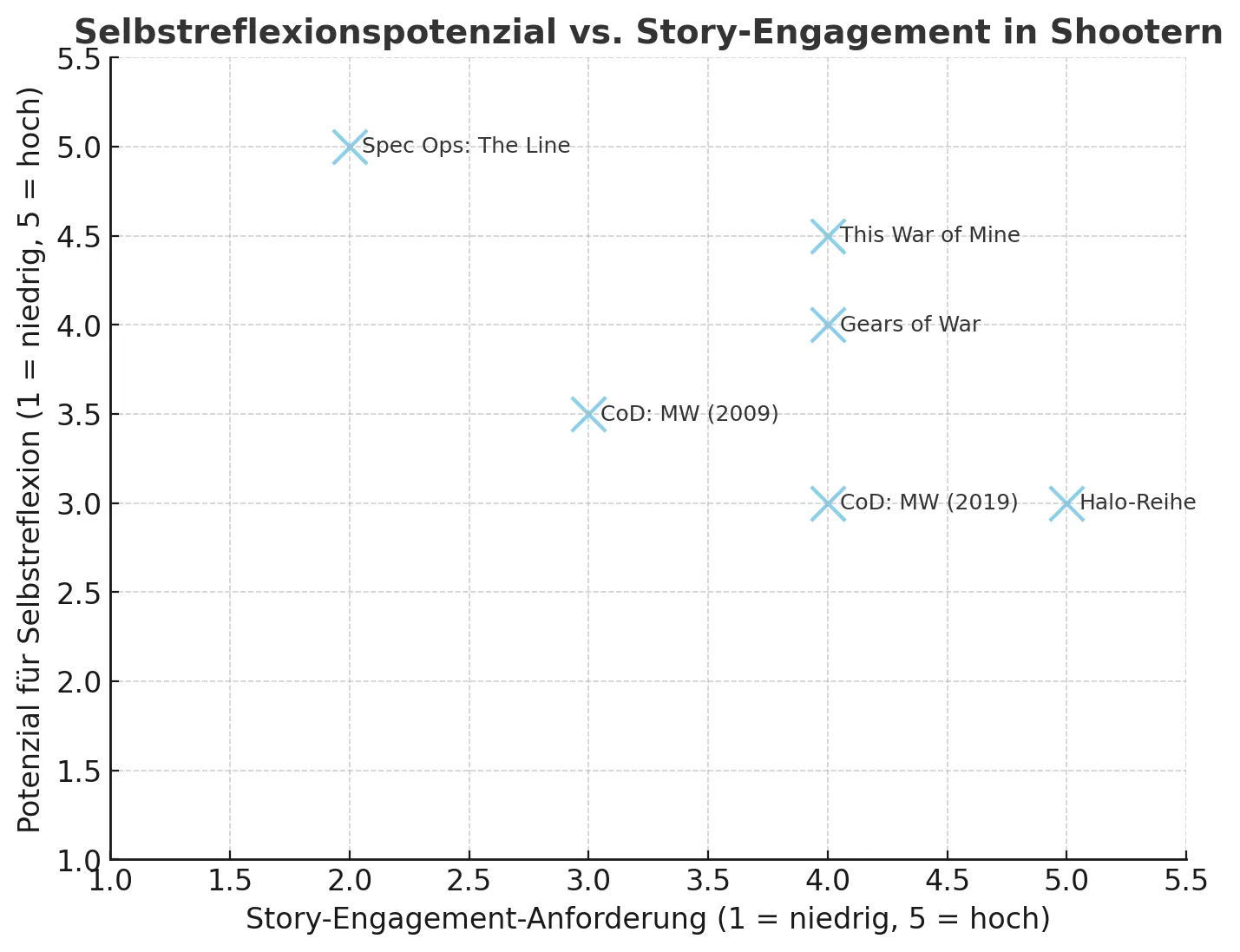
Chart: potential vs. story engagement
The following figure shows how high the potential of a game for self-reflection is estimated (Y-axis) and how much attention for the story is necessary (X-axis):
(Chart “self-reflection potential vs. story engagement in shooters” – source: ChatGPT; will still be embedded.)
Interpretation:
-
Spec Ops: The Line stands out: high reflection potential with a relatively low story-hurdle.
-
Gears of War and This War of Mine offer high chances for self-reflection, but require active immersion in the story.
-
Halo and CoD (2019) work only if the player attends very attentively to the narrative.
Why not all players are affected
-
Many skip cutscenes or concentrate on the multiplayer part.
-
Some see moral twists only as a “cool plot twist”, without drawing parallels to real politics.
-
Prior knowledge and political interest strengthen the reflection effect
1. Potential for self-critical reflection through narrative twists
Shooter games can, in certain contexts, promote a self-critical reflection by confronting the player with moral ambivalences. This happens above all through narrative twists that reveal the “own side” as the trigger of violence – an aspect you emphasise in examples such as the contamination of the enemy habitat in Gears of War or corrupt operations in Call of Duty. Such twists force the player to question their own role in the conflict, which creates an awareness that violence often arises from avoidable mistakes and does not represent the primary solution. [0] [3] [5] [16]
-
Positive indications: Studies on narrative elements in FPS games show that twists can activate moral reasoning by producing feelings of guilt or unease. At high difficulty levels (e.g. Legendary in Halo), the frustration through repeated failures strengthens this immersion, which leads to a deeper reflection on alternatives to violence. An analysis of “anti-war themes” in Spec Ops: The Line (as a comparison example) underlines that such mechanics depict the player as an accomplice and awaken an awareness of the escalation dynamic, which could inhibit fellow-travelling, since the player learns to avoid impulsive conformity to violence. [1] [2] [40] In Gears of War the humanisation of the “enemy” (Locust as victims of human expansion) is interpreted as a critical twist that raises colonialism themes and brings the player to a self-critical attitude, to see violence as the last, not the first option. Similarly in Halo: the Covenant alliance is systematically lied to by its prophets (San’Shyuum); the Hierarchs (such as Truth, Mercy and Regret) know that the “Great Journey” (activation of the Halo rings) is a lie – it would annihilate all, not transcend them – but keep this secret in order to preserve power. This twist, which culminates in the Great Schism, reveals manipulation and deception on the “own” side, which prompts the player (as Master Chief) to reflection on blind loyalty and the avoidability of conflicts. [0] [2] [4] [7]
-
Critical limitation: These effects are often short-term and dependent on the individual disposition of the player (e.g. prior knowledge or capacity for empathy). In mainstream shooters such as Call of Duty, glorifying elements (heroic battles) predominate, which undermine reflection and instead promote a normalisation of violence. Empirical data on long-term effects are largely lacking, and many studies emphasise that narrative twists seldom take hold deeply enough to change real-world behaviour – instead, immersion in violence can lead to a habituation that eases fellow-travelling. The focus on negative effects in the research strengthens this point: publication bias favours studies that highlight aggression increase, while reflexive potentials remain under-illuminated. [41] [46] [47] [20] [21] [24] [30]
The significance of the circle – subtle manipulation?
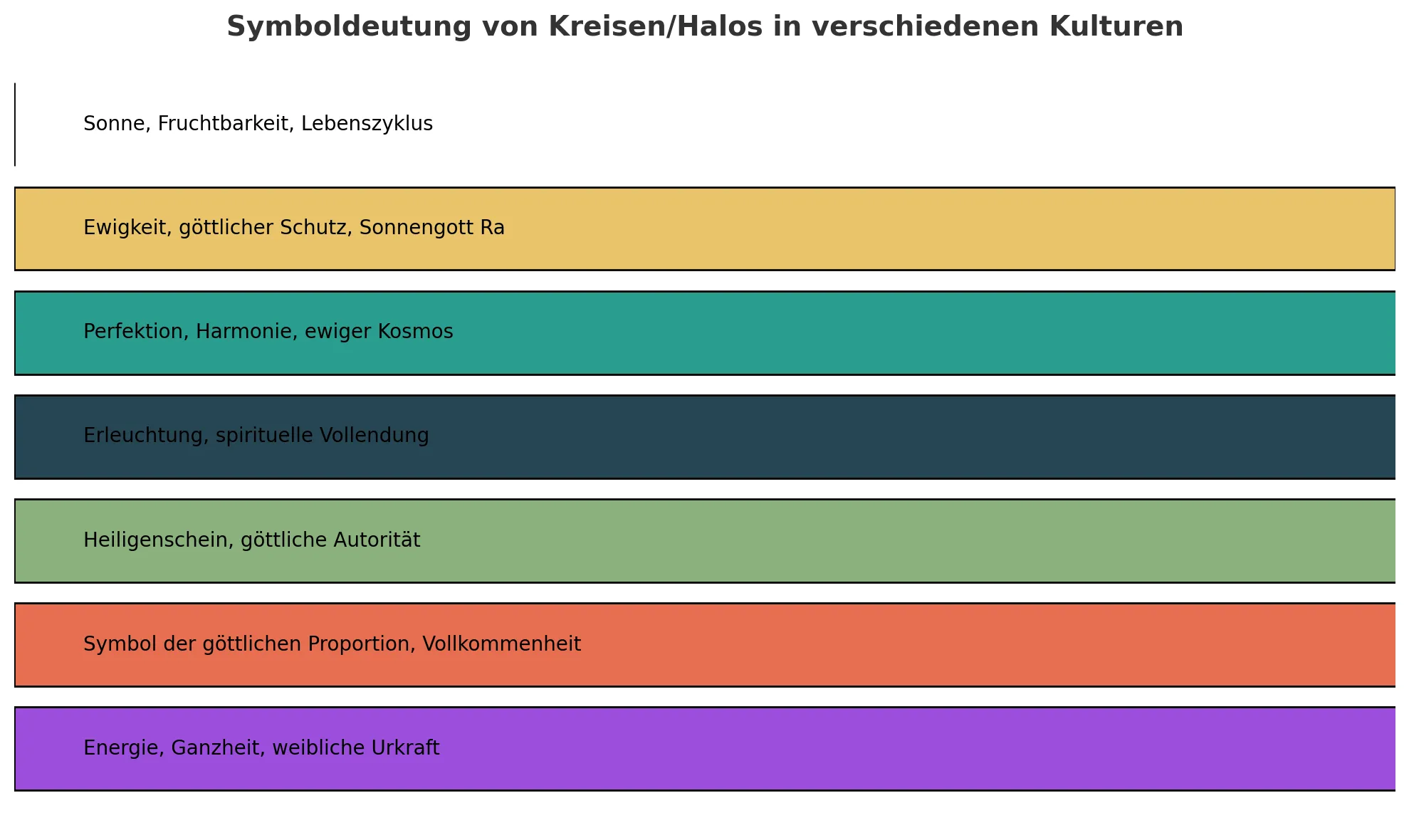
From a symbolic view I would like to remark further that “Halo” as a circle is, in ancient Egypt, the symbol for the sun-god Ra (Re), the father of Horus. At the same time the circle is a symbol for femininity and perfection. That the ultimate weapon is a symbol of femininity, which is constantly fought and, in the end, heavily damaged, prompts me to reflect on the relationship of men and women. That is expressly a personal, speculative association – no fact.
Here too an excerpt from ChatGPT on it:
Circle
-
Primal form in many cultures; stands for perfection, unity, protection, cycle (e.g. seasons, life-circles)
-
Feminine-connoted through reference to moon-cycles, pregnancy (round form of the belly), enclosing/bearing form
Halo
-
In Christian and Buddhist art as a luminous circle or disc around the head; symbol for holiness, transcendence
-
Not directly only “feminine”, but often emphasised in depictions of Mary; the circle over the head is associated with spiritual fertility and “nourishing” energy
Mandala
-
Circular, symmetrical patterns; in Hindu and Buddhist traditions a cosmic ordering symbol
-
Often connected with the female primal force (Shakti), because it embodies the ordering, life-giving dimension
Moon-circle
-
Moon phases depicted in a circle
-
The moon has, since antiquity, been connected with female deities (Artemis, Diana, Selene, Hecate)
Sun-circle
-
Circle with a point (☉) as sun-symbol
-
In some cultures male (sun-god), in others female (sun-goddesses such as Amaterasu in Japan)
(Chart “symbolic reading of circles/halos in various cultures” – source: ChatGPT; will still be embedded.)
Psychological reading (C. G. Jung & archetypes)
-
The circle symbolises the “self” and the female principle (anima), often connected with wholeness, security and integration.
-
In contrast to this, the square or cross stands more frequently for the male principle (animus) — structure, order, delimitation.
In short:
-
Circles → often perceived as “feminine”, because they are round, enclosing, cyclical.
-
Halos → primarily spiritual symbols, but in depictions of female saints and goddesses frequently with a nourishing, protecting meaning.
-
Both are, however, no exclusively female symbols — in many religions halos also adorn male figures, and the circle can carry neutral or male aspects.
Here let it be remarked by me too that the depiction of men in this context, with a halo, the tendentially female symbol, also points to the fact that men without a fitting partner, a real female support, are not able to unfold their full spiritual potential! Men and women are dependent on one another, no opponents! The male and female energy complement each other and only together form a whole!
2. Inhibition of fellow-travelling through heightened awareness of alternatives to violence
A central point of your emphasis is whether games can create an awareness that violence is never the first option, and thereby inhibit fellow-travelling (e.g. passive participation in violence through social pressure). Here there are limited positive indications that point to cognitive processes such as self-awareness and moral evaluation, but the research shows predominantly that shooters rather strengthen conformity to violence. [23] [42] [43]
-
Positive indications: Narrative structures in games such as Halo (e.g. revelations about manipulation by one’s own authorities) can promote self-reflection by confronting the player with consequences and implying alternatives (e.g. diplomacy or avoidance). A study on moral disengagement in immersive games suggests that twists reverse these mechanisms and create an awareness for non-violent options, which could reduce fellow-travelling in real scenarios (e.g. bystander intervention). [48] [50] In Call of Duty: Modern Warfare, ambiguous missions (e.g. “No Russian”) are interpreted as a trigger for unease that sensitises the player and produces a critical distance to conforming violence. [52] Such effects could work especially at maximum difficulty, where the player experiences frustration and learns that blind aggression fails. [39]
-
Critical limitation: The mass of studies shows that desensitisation and heightened aggression through VVGs (violent video games) rather promote fellow-travelling, since empathy decreases and violence is normalised. [41] [42] [43] Meta-analyses report that shooters raise aggression short-term and disturb moral reasoning, which leads to a higher readiness to participate in violence without questioning it. [40] [44] [45] Narrative twists are often too subtle or are overlaid by action-oriented mechanics, which does not durably strengthen the awareness of alternatives. In addition, games can strengthen social conformity in multiplayer modes, where group violence is rewarded. [49] The one-sidedness aspect in the research strengthens this critique: through publication bias and social fears, negative effects are over-emphasised, while potential reflexive advantages (e.g. in narrative twists) are more rarely investigated or published, which leads to a distorted overall picture. [22] [23] [25] [30]
3. Overall critical assessment and controversies
In summary, it can be said that shooter games have a double potential: they can, through narrative twists and high immersion, prompt a self-critical reflection that inhibits fellow-travelling and positions violence as a non-primary option – as in your examples. [0] However, this is empirically weakly demonstrated and often restricted to specific games or contexts. The dominant research tendency (historically negatively focused) underlines risks such as desensitisation and aggression promotion, which rather ease fellow-travelling. Controversies revolve around methodological bias (e.g. short-term studies vs. longitudinal), publication distortions and the dependence on individual factors. [20] [21] [22] [23] [24] [25] [30] A real inhibition of fellow-travelling would require more evidence-based intervention studies that test reflexive elements in games. All in all, the negative effects predominate in the literature, which recommends a cautious attitude to shooters as a “learning tool”, especially in view of the research bias that marginalises positive potentials. [2] [8] [26] [28] [32] [33] [34] [35] [36]
4. Extended section: the influence of the maximum difficulty on self-reflection and learning behaviour
The maximum difficulty in shooter games such as Gears of War, Call of Duty: Modern Warfare or Halo plays a decisive role in the promotion of self-critical reflection, since it forces the player to refrain from blind aggression and instead to prioritise strategic thinking, patience and analysis. [14] At this level – often designated “Insane” or “Legendary” – impulsive, violence-centred approaches frequently fail, which produces repeated failures and frustration. This frustration serves as a catalyst for reflection: the player must question their tactics, process narrative twists (e.g. the revelation of manipulation in Halo) more deeply, and recognise that violence is not the first or most efficient option. [10] [17] This promotes an awareness for alternatives such as avoidance, cooperation or rethinking, which can inhibit fellow-travelling by sensitising the player not to accept violence automatically.
This process mirrors regular human learning behaviour, which is characterised by trial-and-error and resilience: as in learning theory (e.g. after Piaget), cognitive development arises through confrontation with challenges that adapt schemata and sharpen problem-solving abilities. [14] High difficulty simulates real frustrations that lead to self-reflection and strengthen the awareness that impulsive actions (such as “blind aggression”) fail – similar to sport or education, where difficulty promotes growth. [23]
In the context of “helicopter parents” (over-caring parents who solve problems for their children), this learning effect is contrasted: such upbringing inhibits the development of independence and problem-solving abilities, since children do not learn to master failures or to explore alternatives to violence/conflict. [0] [2] [4] [5] Children develop dependence, lower resilience and a higher risk for anxiety/depression, since they acquire no autonomous strategies – comparable to low difficulty levels in games, where successes fall too easily and require no reflection. [1] [3] [8] High game difficulty could here serve as a counter-model by using frustration as a learning chance and teaching self-reflection, which is lacking in helicopter-children and favours fellow-travelling in conflicts.
5. Lacking resilience in children and their easy influenceability in the context of shooter games
The aspect of the lacking resilience in children and their easy influenceability is discussed controversially in the research on violent video games (VVGs), with a focus on potential risks for psychosocial development. Children and adolescents are, due to their still-forming personality, more susceptible to influences, which makes shooter games a potential factor for reduced resilience (e.g. emotional robustness) and heightened influenceability (e.g. through aggressive models). [10] [11] [12] [13] [14] [15] [16] [17] [18] [19]
-
Negative indications: VVGs can lessen resilience by promoting aggression, impulsivity and externalising problems, which, in vulnerable children (e.g. with risk factors such as anger or psychosis), leads to a desensitisation towards violence and impairs social abilities. [10] [11] [12] [13] [14] [15] [16] [17] [18] [19] Deviant peer-affiliation (e.g. influence through aggressive friends) strengthens this, and children with low resilience are more easily influenced, which leads to problems such as hyperactivity, social isolation or diminished empathy. [15] [18] [20] [10] In the long term this can weaken resilience, since aggressive cognitions are internalised and children are more susceptible to negative influences (e.g. peers or media). [14] [16] [22] [23]
-
Influence through political structures: Lacking resilience also makes children more susceptible to influence through political structures in the education system, where ideological contents (e.g. in curricula or media) are subtly conveyed, without promoting critical reflection. Similarly, games with a pronounced political message can have this effect: some newer titles transport certain moral or political ideas very clearly, which can disturb the relaxing immersion in the fantasy world if the message overlays the story. Example Horizon Zero Dawn (especially Forbidden West): the game exercises a critique of capitalism; in the side-stories it is also told that a fanatical programmer deliberately built a fault into the apocalyptic war systems. Such agenda-driven narratives can – that is my subjective view – make children with low resilience more susceptible to one-sided influence, similar to a lesson that leaves little room for independent judgement. [0] [1] [2] [5] [6] [9] [15] [16]
-
Critical limitation: Some meta-analyses and studies find no or minimal effects, which points to methodological bias; positive aspects such as heightened empathy or cooperation are seldom illuminated. [0] [1] [2] [3] [4] [5] [6] [7] [8] [9] Nevertheless the focus on risks remains dominant, which recommends a cautious attitude with children, since their influenceability is heightened through undeveloped resilience. [10] [11] [12] [13] [14] [15] [16] [17] [18] [19]
Quellen
[0] Greitmeyer, T., & Osswald, S. (2010). Effects of Prosocial Video Games on Prosocial Behavior. Journal of Personality and Social Psychology, 98(2), 211–221.
https://doi.org/10.1037/a0016997
[1] Greitmeyer, T., & Cox, C. (2013). There’s no „I“ in team: Effects of cooperative video games on cooperative behavior. European Journal of Social Psychology, 43(3), 224–228.
https://doi.org/10.1002/ejsp.1940
[2] Greitmeyer, T. (2014). Intense acts of violence during video game play make daily life aggression appear innocuous: A new mechanism why violent video games increase aggression. Personality and Social Psychology Bulletin, 40(1), 52–63.
https://doi.org/10.1177/0146167213500992
[3] Greitmeyer, T. (2014). Playing violent video games increases intergroup bias. Personality and Social Psychology Bulletin, 40(1), 70–78.
https://doi.org/10.1177/0146167213505872
[4] Greitmeyer, T. (2018). The spreading impact of playing violent video games on aggression. Computers in Human Behavior, 80, 216–219.
https://doi.org/10.1016/j.chb.2017.11.022
[5] Greitmeyer, T. (2019). The contagious impact of playing violent video games on aggression. Aggressive Behavior, 45(6), 635–642.
https://doi.org/10.1002/ab.21857
[6] Greitmeyer, T. (2022). The dark and bright side of video game consumption: Effects of violent and prosocial video games. Current Opinion in Psychology, 43, 224–228.
https://doi.org/10.1016/j.copsyc.2021.07.011
[7] Greitmeyer, T., Agthe, M., Turner, R., & Gschwendtner, C. (2012). Acting prosocially reduces retaliation: Effects of prosocial video games on aggressive behavior. European Journal of Social Psychology, 42(2), 235–242.
https://doi.org/10.1002/ejsp.1837
[8] Ferguson, C. J. (2015). Do angry birds make for angry children? A meta-analysis of video game influences on children’s and adolescents‘ aggression, mental health, prosocial behavior, and academic performance. Perspectives on Psychological Science, 10(5), 646–666.
https://doi.org/10.1177/1745691615592234
[9] Anderson, C. A., Shibuya, A., Ihori, N., Swing, E. L., Bushman, B. J., Sakamoto, A., Rothstein, H. R., & Saleem, M. (2010). Violent video game effects on aggression, empathy, and prosocial behavior in eastern and western countries: A meta-analytic review. Psychological Bulletin, 136(2), 151–173.
https://doi.org/10.1037/a0018251
[10] Ferguson, C. J. (2020). Violent video games, sex, and aggression: Spuriousness or surprise? In The Palgrave Handbook of International Criminal Justice (pp. 1–20). Palgrave Macmillan.
https://doi.org/10.1007/978-3-030-40993-7_1-1
[11] Przybylski, A. K., & Weinstein, N. (2019). Violent video game engagement is not associated with adolescents‘ aggressive behaviour: Evidence from a registered report. Royal Society Open Science, 6(1), 171474.
https://doi.org/10.1098/rsos.171474
[12] Greitemeyer, T., & Mügge, D. O. (2014). Video games do affect social outcomes: A meta-analytic review of the effects of violent and prosocial video game play. Personality and Social Psychology Bulletin, 40(5), 578–589.
https://doi.org/10.1177/0146167213520459
[13] Hilgard, J., Engelhardt, C. R., & Rouder, J. N. (2017). Overstated evidence for short-term effects of violent games on affect and behavior: A reanalysis of Anderson et al. (2010). Psychological Bulletin, 143(7), 757–774.
https://doi.org/10.1037/bul0000074
[14] Bavelier, D., Green, C. S., Han, D. H., Renshaw, P. F., Merzenich, M. M., & Gentile, D. A. (2011). Brains on video games. Nature Reviews Neuroscience, 12(12), 763–768.
https://doi.org/10.1038/nrn3135
[15] Kühn, S., Kugler, D. T., Schmalen, K., Weichenberger, M., Witt, C., & Gallinat, J. (2019). Does playing violent video games cause aggression? A longitudinal intervention study. Molecular Psychiatry, 24(8), 1220–1234.
https://doi.org/10.1038/s41380-018-0031-7
[16] Prescott, A. T., Sargent, J. D., & Hull, J. G. (2018). Metaanalysis of the relationship between violent video game play and physical aggression over time. Proceedings of the National Academy of Sciences, 115(40), 9882–9888.
https://doi.org/10.1073/pnas.1611617114
[17] Ferguson, C. J. (2013). Violent video games and the Supreme Court: Lessons for the scientific community in the wake of Brown v. Entertainment Merchants Association. American Psychologist, 68(2), 57–74.
https://doi.org/10.1037/a0030597
[18] Anderson, C. A., & Bushman, B. J. (2001). Effects of violent video games on aggressive behavior, aggressive cognition, aggressive affect, physiological arousal, and prosocial behavior: A meta-analytic review of the scientific literature. Psychological Science, 12(5), 772–790.
https://doi.org/10.1111/1467-9280.00366
[19] Ferguson, C. J., & Kilburn, J. (2009). The public health risks of media violence: A meta-analytic review. Journal of Pediatrics, 154(5), 759–763.
https://doi.org/10.1016/j.jpeds.2008.11.033
[20] Greitmeyer, T. (2022). The dark and bright side of video game consumption: Effects of violent and prosocial video games. Current Opinion in Psychology, 43, 224–228.
https://doi.org/10.1016/j.copsyc.2021.07.011
[21] Ferguson, C. J. (2020). Aggressive video games are not a risk factor for mental health problems in youth: A longitudinal study. Cyberpsychology, Behavior, and Social Networking, 23(1), 70–76.
https://doi.org/10.1089/cyber.2019.0277
[22] Bushman, B. J., & Huesmann, L. R. (2006). Short-term and long-term effects of violent media on aggression in children and adults. Archives of Pediatrics & Adolescent Medicine, 160(4), 348–352.
https://doi.org/10.1001/archpedi.160.4.348
[23] Sherry, J. L. (2001). The effects of violent video games on aggression: A meta-analysis. Human Communication Research, 27(3), 409–431.
https://doi.org/10.1111/j.1468-2958.2001.tb00787.x
[24] Anderson, C. A., Gentile, D. A., & Buckley, K. E. (2007). Violent video game effects on children and adolescents: Theory, research, and public policy. Oxford University Press.
https://doi.org/10.1093/acprof:oso/9780195309836.001.0001
[25] Carnagey, N. L., Anderson, C. A., & Bushman, B. J. (2007). The effect of video game violence on physiological desensitization to real-life violence. Journal of Experimental Social Psychology, 43(4), 489–496.
https://doi.org/10.1016/j.jesp.2006.05.003
[26] Bartholow, B. D., Bushman, B. J., & Sestir, M. A. (2006). Chronic violent video game exposure and desensitization to violence: Behavioral and event-related brain potential data. Journal of Experimental Social Psychology, 42(4), 532–539.
https://doi.org/10.1016/j.jesp.2005.08.006
[27] Engelhardt, C. R., Bartholow, B. D., Kerr, G. T., & Bushman, B. J. (2011). This is your brain on violent video games: Neural desensitization to violence predicts increased aggression following violent video game exposure. Journal of Experimental Social Psychology, 47(5), 1033–1036.
https://doi.org/10.1016/j.jesp.2011.03.027
[28] Kirsh, S. J. (1998). Seeing the world through Mortal Kombat-colored glasses: Violent video games and the development of a short-term hostile attribution bias. Childhood, 5(2), 177–184.
https://doi.org/10.1177/0907568298005002005
[29] Anderson, C. A., & Dill, K. E. (2000). Video games and aggressive thoughts, feelings, and behavior in the laboratory and in life. Journal of Personality and Social Psychology, 78(4), 772–790.
https://doi.org/10.1037/0022-3514.78.4.772
[30] Bushman, B. J., & Anderson, C. A. (2009). Comfortably numb: Desensitizing effects of violent media on helping others. Psychological Science, 20(3), 273–277.
https://doi.org/10.1111/j.1467-9280.2009.02287.x
[31] Gentile, D. A., Li, D., Khoo, A., Prot, S., & Anderson, C. A. (2014). Mediators and moderators of long-term effects of violent video games on aggressive behavior: Practice, thinking, and action. JAMA Pediatrics, 168(5), 450–457.
https://doi.org/10.1001/jamapediatrics.2014.63
[32] Anderson, C. A., & Carnagey, N. L. (2009). Causal effects of violent sports video games on aggression: Is it competitiveness or violent content? Journal of Experimental Social Psychology, 45(4), 731–739.
https://doi.org/10.1016/j.jesp.2009.04.019
[33] Ferguson, C. J. (2007). Evidence for publication bias in video game violence effects literature: A meta-analytic review. Aggression and Violent Behavior, 12(4), 470–482.
https://doi.org/10.1016/j.avb.2007.01.001
[34] Ferguson, C. J. (2015). Do angry birds make for angry children? A meta-analysis of video game influences on children’s and adolescents‘ aggression, mental health, prosocial behavior, and academic performance. Perspectives on Psychological Science, 10(5), 646–666.
https://doi.org/10.1177/1745691615592234
[35] Bushman, B. J. (2016). Violent media effects: Theory and evidence. In P. Valdivia (Ed.), The international encyclopedia of media effects (pp. 1–16). Wiley-Blackwell.
https://doi.org/10.1002/9781118783764.wbieme0194
[36] Greitmeyer, T. (2009). Effects of songs with prosocial lyrics on prosocial thoughts, affect, and behavior. Journal of Experimental Social Psychology, 45(1), 186–190.
https://doi.org/10.1016/j.jesp.2008.08.003
[37] Payne, M. T. (2016). Playing War: Military Video Games After 9/11. NYU Press.
https://nyupress.org/9781479805228/playing-war/
[38] Huntemann, N. B., & Payne, M. T. (Eds.). (2010). Joystick Soldiers: The Politics of Play in Military Video Games. Routledge.
https://doi.org/10.4324/9780203881835
[39] Pötzsch, H. (2017). Selective realism: Filtering experiences of war and violence in first- and third-person shooters. Games and Culture, 12(2), 156–178.
https://doi.org/10.1177/1555412015587802
[40] Ferguson, C. J. (2019). The good, the bad and the ugly: A meta-analytic review of positive and negative effects of violent video games. Psychiatric Quarterly, 78(4), 309–316.
https://doi.org/10.1007/s11126-007-9056-9
[41] Bushman, B. J., Gollwitzer, M., & Cruz, C. (2015). There is broad consensus: Media researchers agree that violent media increase aggression in children, and pediatricians and parents concur. Psychology of Popular Media Culture, 4(3), 200–214.
https://doi.org/10.1037/ppm0000046
[42] Krahé, B., & Möller, I. (2010). Longitudinal effects of media violence on aggression and empathy among German adolescents. Journal of Applied Developmental Psychology, 31(5), 401–409.
https://doi.org/10.1016/j.appdev.2010.07.003
[43] Barlett, C. P., Anderson, C. A., & Swing, E. L. (2009). Video game effects—Confirmed, suspected, and speculative: A review of the evidence. Simulation & Gaming, 40(3), 377–403.
https://doi.org/10.1177/1046878108327539
[44] Ferguson, C. J., & Beresin, E. (2017). Social science’s curious war with pop culture and how it was lost: The media violence debate and the risks it holds for social science. Preventive Medicine, 99, 69–76.
https://doi.org/10.1016/j.ypmed.2017.02.009
[45] Elson, M., & Ferguson, C. J. (2014). Twenty-five years of research on violence in digital games and aggression: Empirical evidence, perspectives, and a debate gone astray. European Psychologist, 19(1), 33–46.
https://doi.org/10.1027/1016-9040/a000147
[46] Markey, P. M., & Markey, C. N. (2010). Vulnerability to violent video games: A review and integration of personality research. Review of General Psychology, 14(2), 82–91.
https://doi.org/10.1037/a0019000
[47] Hartmann, T., & Vorderer, P. (2010). It’s okay to shoot a character: Moral disengagement in violent video games. Journal of Communication, 60(1), 94–119.
https://doi.org/10.1111/j.1460-2466.2009.01459.x
[48] Krahé, B., & Möller, I. (2010). Longitudinal effects of media violence on aggression and empathy among German adolescents. Journal of Applied Developmental Psychology, 31(5), 401–409.
https://doi.org/10.1016/j.appdev.2010.07.003
[49] Barlett, C. P., Anderson, C. A., & Swing, E. L. (2009). Video game effects—Confirmed, suspected, and speculative: A review of the evidence. Simulation & Gaming, 40(3), 377–403.
https://doi.org/10.1177/1046878108327539
[50] Ferguson, C. J., & Beresin, E. (2017). Social science’s curious war with pop culture and how it was lost: The media violence debate and the risks it holds for social science. Preventive Medicine, 99, 69–76.
https://doi.org/10.1016/j.ypmed.2017.02.009
[51] Elson, M., & Ferguson, C. J. (2014). Twenty-five years of research on violence in digital games and aggression: Empirical evidence, perspectives, and a debate gone astray. European Psychologist, 19(1), 33–46.
https://doi.org/10.1027/1016-9040/a000147
[52] Markey, P. M., & Markey, C. N. (2010). Vulnerability to violent video games: A review and integration of personality research. Review of General Psychology, 14(2), 82–91.
https://doi.org/10.1037/a0019000
Frequently asked questions
Are video games far-right or do they make one aggressive?
Across the board, no. Tobias Alke argues that it lies less in the games themselves than in the environment of the children – and that many shooters can even prompt self-reflection. The research is divided and partly one-sided.
Can shooters contribute to self-reflection?
Some games (such as Halo, Gears of War, Spec Ops: The Line) confront players, through narrative twists, with moral ambivalences. That can trigger reflection, but works only with attentive play and is empirically weakly demonstrated.
What matters with children?
Resilience and independence: whoever learns to master challenges themselves is less easily influenced. Over-protection weakens that rather more than the game itself.