電子遊戲是右翼激進?——先深呼吸一下
Autor: Tobias O. R. Alke
觀點,而非百科詞條。 托比亞斯·阿爾克(社會學家)一份詳盡、有來源支撐 的分析——借人工智慧系統(Grok、ChatGPT)的考究之助與自身的遊玩經驗;個別段落標註為人工智慧所作。背景知識:百科詞條 気/人工智慧。
摘要
大概可以問心無愧地概括:促進自立的行為,會導向孩子精神狀態的強化。簡單的獎賞助長可疑的行為,而獎賞與績效在此大概尤其致命!可見,孩子是否變得有攻擊性、尤其他們是否發展出一種與績效的關係,問題更在孩子的環境,而非遊戲本身。誰想應對一個問題,就必須付出相應的努力,唯有藉此他才建立起韌性,唯有藉此他才成熟為一個成年之人。若缺此,便會過度地助長其被外來意識形態影響的可能,並造就一個身份失調、在外部尋求方向、並經由從眾現象顯出高於平均之暴力傾向潛能的人。
這就我們社會當下的種種問題,向我們說明了什麼?
導言

公眾憤慨的下一個替罪羊,顯然又該是玩家了——天天如此!在我上學的時候(尤其 1998–2007 年),公眾場合的攻擊行為也總被歸咎於所謂「第一人稱射擊遊戲」的玩家(這究竟屬不屬實無所謂),即那些搬演戰爭或類戰爭情景、或在此語境下呈現之科幻情景的遊戲。這些呼聲當年也幾乎總來自「憂心的家長」的方向——主要出自公立學校的教師群體。雖被汙名化,我仍然玩這些遊戲,卻很少分享我從中獲得的樂趣,除了與來自不同國家的個別朋友。今天新添的:如今玩家還順帶成了「右翼極端分子」,若照「聯邦政治教育局(bpb)」的說法。這家機構的一場研習課,我在海德堡求學期間去過,因內容乏善可陳而提前退出;它於我個人沒什麼說服力,在我看來太片面了。——第一天研習之後,我一大早便動身回家,去最近的火車站,並如當時許多旅館裡常見的那樣,把鑰匙插在走廊外面的門上。由此引出對我本人為期一天的查訪、看我是否被綁架了,但警察也沒被通知(人是這麼告訴我的)!這主意也真虧他們想得出來!可給我手機打個電話,卻誰也沒想到——參與者名單明明在研習課帶領者手上——所謂周密的查訪,也就這麼回事 😉
因為我從自身經驗出發,對第一人稱射擊、並對電子遊戲一般,有一套極為獨到的看法,我在此用 Grok4 與 ChatGPT5 做了些考究,並以我自己在幾款所提及遊戲中的經驗加以充實。出發材料是 Tobias Greitmeyer 的兩篇著作,我在我的碩士論文(《Ausgewählte Perspektiven des Altruismus》,海德堡大學)裡處理過它們。我的碩士論文講的是:人是善還是不善、以及他如何成為他所是。道德與倫理是我畢業論文的核心組成部分。
此處也請留意我父親的書:《Die Ethik des neuen Menschen》(新人的倫理)。
而誰若不願相信我把這些遊戲玩到了這般深度(其中許多是在我求學期間),儘可在此核查——為此人會從這些網路得到「成就/獎盃」,其內容可在網上多方查考,甚至各自的日期應該都可查得:
-
Xbox: SkyFly1987 –
-
PSN: RKomplexity –
以下便是與 @Grok 及 ChatGPT 的討論 / Grok 整體上顯得分寸細緻得多。儘管如此,與這兩個系統總共約 2 小時的討論!
誠摯的問候,
托比亞斯
對射擊遊戲在自我反思與暴力行為上之效應的批判性呈現
基於對話過程中從心理學、媒介學與文化分析研究中——尤其關於 Gears of War、Call of Duty: Modern Warfare 與 Halo 等射擊遊戲——彙集的資訊,我作一份批判性的呈現。焦點在你所強調的諸方面:對一種自我批判之反思的強化(它可能傾向於抑制暴力中的盲從),以及「暴力永遠不該是第一選項」這一意識。我既照亮潛在的積極機制,也照亮佔主導的負面效應,以提供一種均衡而批判的視角。此分析基於過程中所討論的經驗線索、元分析與敘事分析,並凸顯爭議與侷限。此外,我把研究片面性這一情形一併納入:在電子遊戲研究裡,歷史上與主題上都以負面效應(如攻擊性增加)為焦點,這由社會恐懼與發表偏倚所驅動;積極或反思性的面向往往被低估,從而導致一種扭曲的認知。[20] [21] [24] [30]
當射擊遊戲玩家陷入沉思——電子遊戲何時能引發自我反思
本節由 ChatGPT 所作
許多第一人稱射擊遊戲以快節奏動作、競技與壯觀的爆炸著稱——而非道德上的自我懷疑。可有些遊戲,甚至在主流之中,含有出人意料的轉折,能讓玩家去追問其自身的角色與那虛構的戰爭。
自我反思在遊戲中如何生成?
從心理學看,反思往往在三個因素交匯時發生:
-
高沉浸——玩家深深潛入遊戲世界,常經由高難度與在一場戰役中較長的遊玩時間。
-
敘事的斷裂——一次揭示或劇情反轉表明,自己的角色也許站在「錯誤的」一邊、或做過道德上可疑的行為。
-
認知失調——既往的英雄形象與新資訊之間的差異,逼人去追問自己的所為。
來自知名遊戲的例子
-
Gears of War:後來變得清楚:自己的政府經由環境破壞,把敵人逼入了戰爭。
-
Call of Duty: Modern Warfare (2009):備受爭議的「No Russian」任務把玩家逼入一個道德上成問題的角色。(我個人不熟悉)
-
Call of Duty: Modern Warfare (2019):微妙的宣傳元素與假旗揭示,丟擲關於戰爭正當性的種種問題。
-
Halo 系列:揭示人類不只是受害者,也奉行侵略性的擴張政策(NATO?)。與此同時,敵方「星盟」被就其犧牲之必要與那偉大的旅程所欺騙。
-
Spec Ops: The Line:直接讓玩家面對自己虛擬的戰爭罪行——一款有意為道德反思而設計的遊戲。(我個人不熟悉)
-
This War of Mine:讓玩家從平民的視角經歷戰爭,帶著日常的道德兩難。(我個人不熟悉)
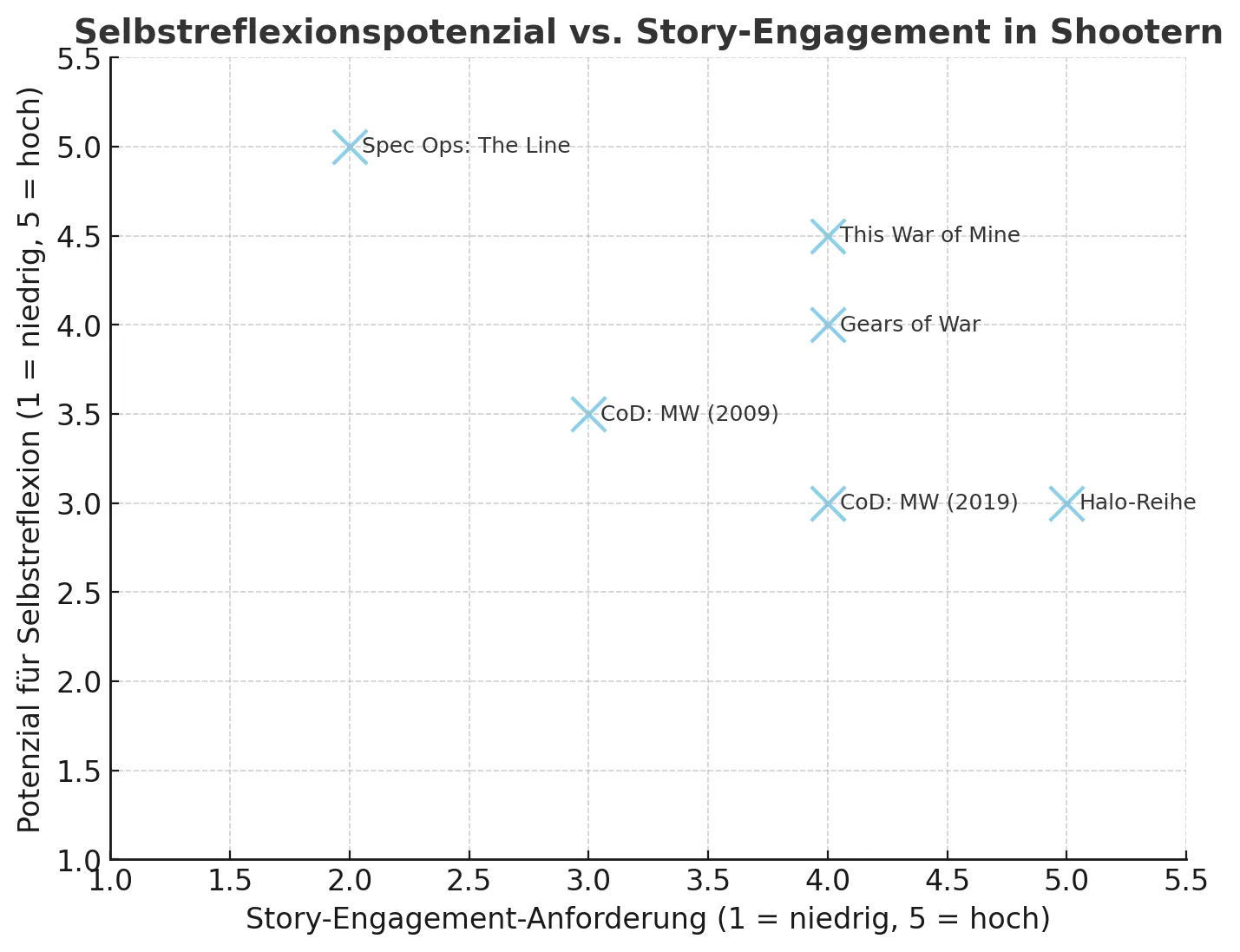
圖:潛能 vs. 劇情投入
下圖顯示一款遊戲的自我反思潛能被評估得有多高(Y 軸),以及需要對劇情投入多少注意力(X 軸):
(圖「射擊遊戲中自我反思潛能 vs. 劇情投入」——來源:ChatGPT;將後續嵌入。)
詮釋:
-
Spec Ops: The Line 突出:高反思潛能而劇情門檻相對較低。
-
Gears of War 與 This War of Mine 提供高的自我反思機會,但要求主動潛入劇情。
-
Halo 與 CoD (2019) 只在玩家極其留心敘事時才起作用。
為何並非所有玩家都受影響
-
許多人跳過過場動畫,或專注於多人部分。
-
有些人只把道德的轉折看作「酷炫的劇情反轉」,而不與現實政治作對照。
-
既有知識與政治興趣會加強反思效應。
1. 經由敘事反轉,自我批判之反思的潛能
射擊遊戲在特定語境下能促進一種自我批判的反思,方式是讓玩家面對道德上的兩可。這尤其經由那些揭示「自己一方」為暴力之肇因的敘事轉折而發生——你在諸如 Gears of War 中對敵方棲息地的汙染、或 Call of Duty 中腐敗的行動等例子裡所強調的一個面向。此類反轉逼玩家去追問自己在衝突中的角色,從而生出一種意識:暴力往往生於可避免的錯誤、而非首要的解法。[0] [3] [5] [16]
-
積極線索: 關於 FPS 遊戲中敘事元素的研究表明,反轉能啟用道德推理,方式是引發愧疚或不安。在高難度上(如 Halo 的 Legendary),反覆失敗所致的挫折加強了這種沉浸,從而導向對暴力之替代的更深反思。一篇關於 Spec Ops: The Line 中「反戰主題」的分析(作為比較例子)強調:此類機制把玩家呈現為共犯,並喚起對升級動態的意識,從而可能抑制盲從,因為玩家學會避免對暴力衝動性的隨大流。[1] [2] [40] 在 Gears of War 中,對「敵人」的人性化(Locust 作為人類擴張的受害者)被詮釋為一處批判性的反轉,它丟擲殖民主義主題,並把玩家帶向一種自我批判的態度:把暴力看作最後、而非最先的選項。類似地在 Halo 中:星盟被其先知(San’Shyuum)系統地欺騙;那些主宰者(如 Truth、Mercy 與 Regret)知道「Great Journey」(啟用 Halo 環)是一個謊言——它會毀滅一切,而非超越——卻為保住權力而將此隱瞞。這一在 Great Schism 中達到高潮的反轉,揭示了「自己」一方的操縱與欺騙,從而激勵玩家(作為 Master Chief)去反思盲目的忠誠與衝突的可避免性。[0] [2] [4] [7]
-
批判性的侷限: 這些效應往往是短期的,並取決於玩家個人的稟性(如既有知識或共情能力)。在 Call of Duty 等主流射擊遊戲中,美化性的元素(英雄式的戰鬥)佔了上風,它們侵蝕反思、反倒助長對暴力的常態化。關於長期效應的經驗資料在很大程度上缺失,而許多研究強調:敘事的反轉鮮少深入到足以改變現實世界的行為——反倒是對暴力的沉浸可能導向一種習慣化,從而使盲從更為容易。研究中對負面效應的聚焦加強了這一點:發表偏倚偏袒那些凸顯攻擊性增加的研究,而反思性的潛能仍未被充分照亮。[41] [46] [47] [20] [21] [24] [30]
圓的意義——微妙的操縱?
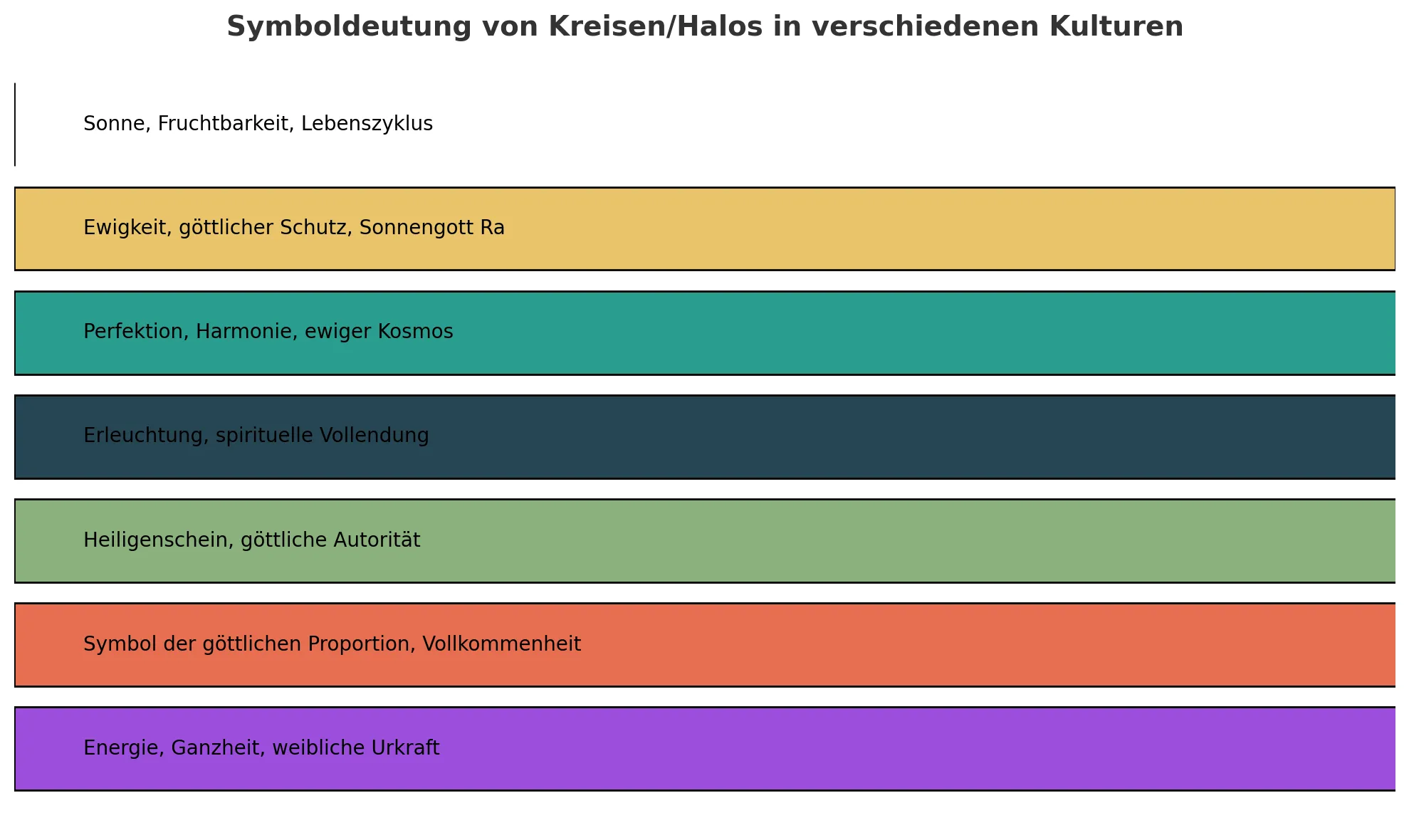
從象徵的角度,我還想指出:「Halo」作為圓,在古埃及是太陽神 Ra(Re)——荷魯斯之父——的象徵。同時,圓是女性與圓滿的象徵。那終極的武器是一個女性的象徵、卻不斷被攻擊、並在最後受到重創,這激勵我去思考男女的關係。這明確是一種個人的、思辨性的聯想——而非事實。
此處再附一段 ChatGPT 關於此的內容:
圓
-
許多文化中的原型;代表圓滿、合一、護佑、迴圈(如四季、生命之圈)
-
借與月相、妊娠(腹部的圓形)、環抱/孕育之形的關聯,帶女性的意涵
光環/聖光環
-
在基督教與佛教藝術中,作為頭部四周發光的圓或盤;聖潔、超越的象徵
-
並非只直接「女性」,但常在聖母像中被強調;頭上的那個圓被與靈性的豐產及「滋養」的能量相關聯
曼陀羅
-
圓形、對稱的圖案;在印度教與佛教傳統中是宇宙秩序的象徵
-
常被與女性的本源之力(Shakti)相連結,因為它體現那有序、賜予生命的維度
月輪
-
月相呈圓而列
-
自古以來,月被與女性神祇(Artemis、Diana、Selene、Hekate)相連結
日輪
-
帶一點的圓(☉)作為太陽的象徵
-
在一些文化中為男性(太陽神),在另一些中為女性(如日本的天照 Amaterasu 等太陽女神)
(圖「圓/光環在不同文化中的象徵意義」——來源:ChatGPT;將後續嵌入。)
心理學的詮釋(C. G. 榮格與原型)
-
圓象徵「自性」與女性原則(阿尼瑪,Anima),常與整全、庇護與整合相連。
-
與之相對,方或十字更常代表男性原則(阿尼姆斯,Animus)——結構、秩序、界分。
簡而言之:
-
圓 → 常被知覺為「女性」,因為它圓、環抱、迴圈。
-
光環 → 首先是靈性的象徵,但在女性聖者與女神像中常帶滋養、護佑的意義。
-
但二者都不是僅屬女性的象徵——在許多宗教中,光環也裝點男性形象,而圓能承載中性或男性的面向。
此處也由我補一句:男性在此語境中、帶著光環(這偏女性的象徵)的呈現,也暗示:男性若沒有一位相配的伴侶、一份真正的女性支援,便無法舒展其完整的靈性潛能!男與女彼此依賴,而非對手!男性與女性的能量相互補足,唯有一同才構成一個整體!
2. 經由對暴力替代之意識的提升,抑制盲從
你所強調的一個核心點是:遊戲能否造就一種意識——暴力永不是第一選項,並藉此抑制盲從(如經由社會壓力對暴力的被動參與)。此處有有限的積極跡象,指向自我意識與道德評估等認知過程,但研究總體顯示:射擊遊戲更是加強對暴力的隨大流。[23] [42] [43]
-
積極線索: Halo 等遊戲中的敘事結構(如關於自身權威所行操縱的揭示),能促進自我反思,方式是讓玩家面對後果、並暗示替代(如外交或規避)。一篇關於沉浸式遊戲中道德脫離的研究暗示:反轉能反轉這些機制,並造就一種對非暴力選項的意識,從而可能在現實情景(如旁觀者干預)中減少盲從。[48] [50] 在 Call of Duty: Modern Warfare 中,兩可的任務(如「No Russian」)被詮釋為不安的觸發器,它讓玩家變得敏感、並生出對隨大流之暴力的批判性距離。[52] 此類效應可能尤其在最高難度上起作用——那裡玩家經歷挫折,並學到盲目的攻擊會失敗。[39]
-
批判性的侷限: 大量研究顯示,暴力電子遊戲(VVGs,violent video games)所致的脫敏與攻擊性增加,更是助長盲從,因為共情減少、暴力被常態化。[41] [42] [43] 元分析報告:射擊遊戲短期內提升攻擊性、擾亂道德推理,從而導向一種更高的、不加追問便參與暴力的意願。[40] [44] [45] 敘事的反轉往往太過微妙、或被動作導向的機制所覆蓋,從而不能持久地強化對替代的意識。此外,遊戲能在多人模式中加強社會隨大流——那裡群體暴力受到獎賞。[49] 研究中的片面性面向加強了這一批判:經由發表偏倚與社會恐懼,負面效應被過度強調,而潛在的反思益處(如敘事反轉中的)更少被研究或發表,從而導向一幅扭曲的整體圖景。[22] [23] [25] [30]
3. 總體批判性評斷與爭議
概言之可以說:射擊遊戲有一種雙重的潛能:它們能經由敘事反轉與高沉浸激發一種自我批判的反思,抑制盲從、並把暴力定位為非首要的選項——如你的例子。[0] 然而這在經驗上證據薄弱,且往往限於特定的遊戲或語境。佔主導的研究傾向(歷史上以負面為焦點)凸顯脫敏與助長攻擊性等風險,它們更是使盲從容易。爭議圍繞方法上的偏倚(如短期研究 vs. 縱向研究)、發表扭曲,以及對個體因素的依賴。[20] [21] [22] [23] [24] [25] [30] 一種對盲從的真正抑制,會要求更多基於證據的干預研究,去檢驗遊戲中的反思元素。總體而言,文獻中負面效應占上風,這建議對把射擊遊戲當作「學習工具」持一種審慎的態度,尤其鑑於那把積極潛能邊緣化的研究偏倚。[2] [8] [26] [28] [32] [33] [34] [35] [36]
4. 擴充套件一節:最高難度對自我反思與學習行為的影響
Gears of War、Call of Duty: Modern Warfare 或 Halo 等射擊遊戲中的最高難度,在促進自我批判之反思上起著決定性的作用,因為它逼玩家放下盲目的攻擊、轉而優先運用策略性思考、耐心與分析。[14] 在這一級別上——常被稱作「Insane」或「Legendary」——衝動、以暴力為中心的路數常常失敗,從而產生反覆的失敗與挫折。這種挫折充當反思的催化劑:玩家必須追問其戰術、更深地加工敘事的反轉(如 Halo 中對操縱的揭示),並認識到暴力不是第一或最有效的選項。[10] [17] 這促進一種對規避、協作或改換思路等替代的意識,從而能抑制盲從,方式是讓玩家變得敏感、不自動接受暴力。
這一過程映現著常規的人類學習行為——以試錯與韌性為特徵:如學習理論(如皮亞傑)所述,認知發展經由與挑戰的對峙而生成,它調整圖式、磨礪解決問題的能力。[14] 高難度模擬現實的挫折,導向自我反思、並強化「衝動的行為(如『盲目的攻擊』)會失敗」這一意識——類似體育或教育,那裡難度促進成長。[23]
在「直升機父母」(過度呵護、替孩子解決問題的父母)的語境下,這一學習效應形成對照:此類教養抑制自立與解決問題能力的發展,因為孩子學不會應對失敗、或探索暴力/衝突的替代。[0] [2] [4] [5] 孩子發展出依賴、更低的韌性與更高的焦慮/抑鬱風險,因為他們未習得自主的策略——可比於遊戲中的低難度,那裡成功來得太易、不要求反思。[1] [3] [8] 高遊戲難度在此或能充當一個反模型,方式是把挫折用作學習的機會、並教授自我反思——這在直升機孩子那裡所缺,並在衝突中助長盲從。
5. 孩子韌性的缺失及其在射擊遊戲語境下易被影響
孩子韌性的缺失及其易被影響,在關於暴力電子遊戲(VVGs)的研究中被有爭議地討論,焦點在對社會心理發展的潛在風險。孩子與青少年由於其仍在成形的人格,對影響更為易感,這使射擊遊戲成為韌性降低(如情緒的承受力)與被影響性增加(如經由攻擊性的榜樣)的一個潛在因素。[10] [11] [12] [13] [14] [15] [16] [17] [18] [19]
-
負面線索: VVGs 能降低韌性,方式是助長攻擊、衝動與外化的問題,這在脆弱的孩子(如帶憤怒或精神病等風險因素)那裡導向對暴力的脫敏、並損害社會能力。[10] [11] [12] [13] [14] [15] [16] [17] [18] [19] 越軌的同伴依附(如受攻擊性朋友的影響)加強這一點,而韌性低的孩子更易被影響,從而導向多動、社會孤立或共情減少等問題。[15] [18] [20] [10] 長期而言,這能削弱韌性,因為攻擊性的認知被內化、而孩子對負面影響(如同伴或媒體)更為易感。[14] [16] [22] [23]
-
經由政治結構的影響: 韌性的缺失也使孩子更易受教育體制內政治結構的影響——那裡意識形態的內容(如在課程或媒體中)被微妙地傳遞,而不促進批判性的反思。類似地,帶有 鮮明政治訊息 的遊戲也能有此效應:某些較新的作品極為分明地承載著某些道德或政治的設想,當訊息蓋過故事時,便可能擾亂那放鬆地潛入幻想世界的體驗。以 Horizon Zero Dawn(尤其 Forbidden West)為例:該遊戲批判資本主義;在其支線故事裡還講述,一個狂熱的程式設計師有意在那末世的戰爭系統中埋入一個錯誤。此類議程驅動的敘事——這是我主觀的看法——能使韌性低的孩子更易受片面的影響,類似於一種少給自主判斷留空間的課堂。[0] [1] [2] [5] [6] [9] [15] [16]
-
批判性的侷限: 一些元分析與研究發現沒有或極小的效應,這指向方法上的偏倚;共情增加或協作等積極面向鮮少被照亮。[0] [1] [2] [3] [4] [5] [6] [7] [8] [9] 儘管如此,對風險的聚焦仍佔主導,這建議對孩子持一種審慎的態度,因為其被影響性由於未發育的韌性而增高。[10] [11] [12] [13] [14] [15] [16] [17] [18] [19]
Quellen
[0] Greitmeyer, T., & Osswald, S. (2010). Effects of Prosocial Video Games on Prosocial Behavior. Journal of Personality and Social Psychology, 98(2), 211–221.
https://doi.org/10.1037/a0016997
[1] Greitmeyer, T., & Cox, C. (2013). There’s no „I“ in team: Effects of cooperative video games on cooperative behavior. European Journal of Social Psychology, 43(3), 224–228.
https://doi.org/10.1002/ejsp.1940
[2] Greitmeyer, T. (2014). Intense acts of violence during video game play make daily life aggression appear innocuous: A new mechanism why violent video games increase aggression. Personality and Social Psychology Bulletin, 40(1), 52–63.
https://doi.org/10.1177/0146167213500992
[3] Greitmeyer, T. (2014). Playing violent video games increases intergroup bias. Personality and Social Psychology Bulletin, 40(1), 70–78.
https://doi.org/10.1177/0146167213505872
[4] Greitmeyer, T. (2018). The spreading impact of playing violent video games on aggression. Computers in Human Behavior, 80, 216–219.
https://doi.org/10.1016/j.chb.2017.11.022
[5] Greitmeyer, T. (2019). The contagious impact of playing violent video games on aggression. Aggressive Behavior, 45(6), 635–642.
https://doi.org/10.1002/ab.21857
[6] Greitmeyer, T. (2022). The dark and bright side of video game consumption: Effects of violent and prosocial video games. Current Opinion in Psychology, 43, 224–228.
https://doi.org/10.1016/j.copsyc.2021.07.011
[7] Greitmeyer, T., Agthe, M., Turner, R., & Gschwendtner, C. (2012). Acting prosocially reduces retaliation: Effects of prosocial video games on aggressive behavior. European Journal of Social Psychology, 42(2), 235–242.
https://doi.org/10.1002/ejsp.1837
[8] Ferguson, C. J. (2015). Do angry birds make for angry children? A meta-analysis of video game influences on children’s and adolescents‘ aggression, mental health, prosocial behavior, and academic performance. Perspectives on Psychological Science, 10(5), 646–666.
https://doi.org/10.1177/1745691615592234
[9] Anderson, C. A., Shibuya, A., Ihori, N., Swing, E. L., Bushman, B. J., Sakamoto, A., Rothstein, H. R., & Saleem, M. (2010). Violent video game effects on aggression, empathy, and prosocial behavior in eastern and western countries: A meta-analytic review. Psychological Bulletin, 136(2), 151–173.
https://doi.org/10.1037/a0018251
[10] Ferguson, C. J. (2020). Violent video games, sex, and aggression: Spuriousness or surprise? In The Palgrave Handbook of International Criminal Justice (pp. 1–20). Palgrave Macmillan.
https://doi.org/10.1007/978-3-030-40993-7_1-1
[11] Przybylski, A. K., & Weinstein, N. (2019). Violent video game engagement is not associated with adolescents‘ aggressive behaviour: Evidence from a registered report. Royal Society Open Science, 6(1), 171474.
https://doi.org/10.1098/rsos.171474
[12] Greitemeyer, T., & Mügge, D. O. (2014). Video games do affect social outcomes: A meta-analytic review of the effects of violent and prosocial video game play. Personality and Social Psychology Bulletin, 40(5), 578–589.
https://doi.org/10.1177/0146167213520459
[13] Hilgard, J., Engelhardt, C. R., & Rouder, J. N. (2017). Overstated evidence for short-term effects of violent games on affect and behavior: A reanalysis of Anderson et al. (2010). Psychological Bulletin, 143(7), 757–774.
https://doi.org/10.1037/bul0000074
[14] Bavelier, D., Green, C. S., Han, D. H., Renshaw, P. F., Merzenich, M. M., & Gentile, D. A. (2011). Brains on video games. Nature Reviews Neuroscience, 12(12), 763–768.
https://doi.org/10.1038/nrn3135
[15] Kühn, S., Kugler, D. T., Schmalen, K., Weichenberger, M., Witt, C., & Gallinat, J. (2019). Does playing violent video games cause aggression? A longitudinal intervention study. Molecular Psychiatry, 24(8), 1220–1234.
https://doi.org/10.1038/s41380-018-0031-7
[16] Prescott, A. T., Sargent, J. D., & Hull, J. G. (2018). Metaanalysis of the relationship between violent video game play and physical aggression over time. Proceedings of the National Academy of Sciences, 115(40), 9882–9888.
https://doi.org/10.1073/pnas.1611617114
[17] Ferguson, C. J. (2013). Violent video games and the Supreme Court: Lessons for the scientific community in the wake of Brown v. Entertainment Merchants Association. American Psychologist, 68(2), 57–74.
https://doi.org/10.1037/a0030597
[18] Anderson, C. A., & Bushman, B. J. (2001). Effects of violent video games on aggressive behavior, aggressive cognition, aggressive affect, physiological arousal, and prosocial behavior: A meta-analytic review of the scientific literature. Psychological Science, 12(5), 772–790.
https://doi.org/10.1111/1467-9280.00366
[19] Ferguson, C. J., & Kilburn, J. (2009). The public health risks of media violence: A meta-analytic review. Journal of Pediatrics, 154(5), 759–763.
https://doi.org/10.1016/j.jpeds.2008.11.033
[20] Greitmeyer, T. (2022). The dark and bright side of video game consumption: Effects of violent and prosocial video games. Current Opinion in Psychology, 43, 224–228.
https://doi.org/10.1016/j.copsyc.2021.07.011
[21] Ferguson, C. J. (2020). Aggressive video games are not a risk factor for mental health problems in youth: A longitudinal study. Cyberpsychology, Behavior, and Social Networking, 23(1), 70–76.
https://doi.org/10.1089/cyber.2019.0277
[22] Bushman, B. J., & Huesmann, L. R. (2006). Short-term and long-term effects of violent media on aggression in children and adults. Archives of Pediatrics & Adolescent Medicine, 160(4), 348–352.
https://doi.org/10.1001/archpedi.160.4.348
[23] Sherry, J. L. (2001). The effects of violent video games on aggression: A meta-analysis. Human Communication Research, 27(3), 409–431.
https://doi.org/10.1111/j.1468-2958.2001.tb00787.x
[24] Anderson, C. A., Gentile, D. A., & Buckley, K. E. (2007). Violent video game effects on children and adolescents: Theory, research, and public policy. Oxford University Press.
https://doi.org/10.1093/acprof:oso/9780195309836.001.0001
[25] Carnagey, N. L., Anderson, C. A., & Bushman, B. J. (2007). The effect of video game violence on physiological desensitization to real-life violence. Journal of Experimental Social Psychology, 43(4), 489–496.
https://doi.org/10.1016/j.jesp.2006.05.003
[26] Bartholow, B. D., Bushman, B. J., & Sestir, M. A. (2006). Chronic violent video game exposure and desensitization to violence: Behavioral and event-related brain potential data. Journal of Experimental Social Psychology, 42(4), 532–539.
https://doi.org/10.1016/j.jesp.2005.08.006
[27] Engelhardt, C. R., Bartholow, B. D., Kerr, G. T., & Bushman, B. J. (2011). This is your brain on violent video games: Neural desensitization to violence predicts increased aggression following violent video game exposure. Journal of Experimental Social Psychology, 47(5), 1033–1036.
https://doi.org/10.1016/j.jesp.2011.03.027
[28] Kirsh, S. J. (1998). Seeing the world through Mortal Kombat-colored glasses: Violent video games and the development of a short-term hostile attribution bias. Childhood, 5(2), 177–184.
https://doi.org/10.1177/0907568298005002005
[29] Anderson, C. A., & Dill, K. E. (2000). Video games and aggressive thoughts, feelings, and behavior in the laboratory and in life. Journal of Personality and Social Psychology, 78(4), 772–790.
https://doi.org/10.1037/0022-3514.78.4.772
[30] Bushman, B. J., & Anderson, C. A. (2009). Comfortably numb: Desensitizing effects of violent media on helping others. Psychological Science, 20(3), 273–277.
https://doi.org/10.1111/j.1467-9280.2009.02287.x
[31] Gentile, D. A., Li, D., Khoo, A., Prot, S., & Anderson, C. A. (2014). Mediators and moderators of long-term effects of violent video games on aggressive behavior: Practice, thinking, and action. JAMA Pediatrics, 168(5), 450–457.
https://doi.org/10.1001/jamapediatrics.2014.63
[32] Anderson, C. A., & Carnagey, N. L. (2009). Causal effects of violent sports video games on aggression: Is it competitiveness or violent content? Journal of Experimental Social Psychology, 45(4), 731–739.
https://doi.org/10.1016/j.jesp.2009.04.019
[33] Ferguson, C. J. (2007). Evidence for publication bias in video game violence effects literature: A meta-analytic review. Aggression and Violent Behavior, 12(4), 470–482.
https://doi.org/10.1016/j.avb.2007.01.001
[34] Ferguson, C. J. (2015). Do angry birds make for angry children? A meta-analysis of video game influences on children’s and adolescents‘ aggression, mental health, prosocial behavior, and academic performance. Perspectives on Psychological Science, 10(5), 646–666.
https://doi.org/10.1177/1745691615592234
[35] Bushman, B. J. (2016). Violent media effects: Theory and evidence. In P. Valdivia (Ed.), The international encyclopedia of media effects (pp. 1–16). Wiley-Blackwell.
https://doi.org/10.1002/9781118783764.wbieme0194
[36] Greitmeyer, T. (2009). Effects of songs with prosocial lyrics on prosocial thoughts, affect, and behavior. Journal of Experimental Social Psychology, 45(1), 186–190.
https://doi.org/10.1016/j.jesp.2008.08.003
[37] Payne, M. T. (2016). Playing War: Military Video Games After 9/11. NYU Press.
https://nyupress.org/9781479805228/playing-war/
[38] Huntemann, N. B., & Payne, M. T. (Eds.). (2010). Joystick Soldiers: The Politics of Play in Military Video Games. Routledge.
https://doi.org/10.4324/9780203881835
[39] Pötzsch, H. (2017). Selective realism: Filtering experiences of war and violence in first- and third-person shooters. Games and Culture, 12(2), 156–178.
https://doi.org/10.1177/1555412015587802
[40] Ferguson, C. J. (2019). The good, the bad and the ugly: A meta-analytic review of positive and negative effects of violent video games. Psychiatric Quarterly, 78(4), 309–316.
https://doi.org/10.1007/s11126-007-9056-9
[41] Bushman, B. J., Gollwitzer, M., & Cruz, C. (2015). There is broad consensus: Media researchers agree that violent media increase aggression in children, and pediatricians and parents concur. Psychology of Popular Media Culture, 4(3), 200–214.
https://doi.org/10.1037/ppm0000046
[42] Krahé, B., & Möller, I. (2010). Longitudinal effects of media violence on aggression and empathy among German adolescents. Journal of Applied Developmental Psychology, 31(5), 401–409.
https://doi.org/10.1016/j.appdev.2010.07.003
[43] Barlett, C. P., Anderson, C. A., & Swing, E. L. (2009). Video game effects—Confirmed, suspected, and speculative: A review of the evidence. Simulation & Gaming, 40(3), 377–403.
https://doi.org/10.1177/1046878108327539
[44] Ferguson, C. J., & Beresin, E. (2017). Social science’s curious war with pop culture and how it was lost: The media violence debate and the risks it holds for social science. Preventive Medicine, 99, 69–76.
https://doi.org/10.1016/j.ypmed.2017.02.009
[45] Elson, M., & Ferguson, C. J. (2014). Twenty-five years of research on violence in digital games and aggression: Empirical evidence, perspectives, and a debate gone astray. European Psychologist, 19(1), 33–46.
https://doi.org/10.1027/1016-9040/a000147
[46] Markey, P. M., & Markey, C. N. (2010). Vulnerability to violent video games: A review and integration of personality research. Review of General Psychology, 14(2), 82–91.
https://doi.org/10.1037/a0019000
[47] Hartmann, T., & Vorderer, P. (2010). It’s okay to shoot a character: Moral disengagement in violent video games. Journal of Communication, 60(1), 94–119.
https://doi.org/10.1111/j.1460-2466.2009.01459.x
[48] Krahé, B., & Möller, I. (2010). Longitudinal effects of media violence on aggression and empathy among German adolescents. Journal of Applied Developmental Psychology, 31(5), 401–409.
https://doi.org/10.1016/j.appdev.2010.07.003
[49] Barlett, C. P., Anderson, C. A., & Swing, E. L. (2009). Video game effects—Confirmed, suspected, and speculative: A review of the evidence. Simulation & Gaming, 40(3), 377–403.
https://doi.org/10.1177/1046878108327539
[50] Ferguson, C. J., & Beresin, E. (2017). Social science’s curious war with pop culture and how it was lost: The media violence debate and the risks it holds for social science. Preventive Medicine, 99, 69–76.
https://doi.org/10.1016/j.ypmed.2017.02.009
[51] Elson, M., & Ferguson, C. J. (2014). Twenty-five years of research on violence in digital games and aggression: Empirical evidence, perspectives, and a debate gone astray. European Psychologist, 19(1), 33–46.
https://doi.org/10.1027/1016-9040/a000147
[52] Markey, P. M., & Markey, C. N. (2010). Vulnerability to violent video games: A review and integration of personality research. Review of General Psychology, 14(2), 82–91.
常見問題
電子遊戲是右翼極端的、或讓人有攻擊性嗎?
籠統地說不。托比亞斯·阿爾克論證,問題更在孩子的環境、而非遊戲本身——而許多射擊遊戲甚至能激發自我反思。研究眾說不一、且部分片面。
射擊遊戲能有助於自我反思嗎?
某些遊戲(如 Halo、Gears of War、Spec Ops: The Line)經由敘事的轉折,讓玩家面對道德上的兩可。這能引發反思,但只在專注的遊玩中起作用,且經驗證據薄弱。
在孩子那裡,關鍵是什麼?
在於韌性與自立:學會自己應對挑戰的人,更不易被影響。過度保護對此的削弱,甚於遊戲本身。