The search for the Holy Grail, 1990
Autor: D. Harald Alke
A standpoint, not an encyclopedia entry. An expressly subjective, open trace-seeking by D. Harald Alke – research with an open outcome, no assertion of fact. Background knowledge on faith and religions: encyclopedia entry Religion. Related: The Holy Grail and St Maries-de-la-Mèr.
How I came onto the trace of the Grail
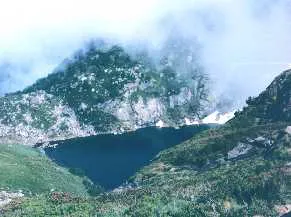
I knew nothing further about the Grail, but then I gave a young technician from Air France a lift as a hitchhiker, and he told me about the Cathars. Then I myself had these dramatic encounters with the ravens on Puivert, my visions with the dying whales, and suddenly I was right in the middle of it. The land itself, the Pyrenees and especially their French side, are steeped in this vibration. Once a sensitive person has got into it, has once tasted of it, then they can track it down everywhere. I have always concerned myself with old fairy tales and sagas, for they contain many valuable hints of old cultures, of magic, of the gods, of mystical phenomena. The Grail kept surfacing. I have a knack for seemingly by chance addressing strangers who then have exactly the old information I am searching for.
Otto Rahn and the trail of the Cathars
Back in Germany I found an old edition of Otto Rahn’s “Kreuzzug gegen den Gral”. After that I read medieval sagas and traditions. My images and premonitions became clearer, that the Grail story has a true core. Further extraordinary events occurred on various Cathar castles, and in the village of Montségur a village pub surfaced and soon disappeared again.
An article by me on the theme of the Grail appeared in the magazine “Rätselhafte Phänomene” in 1990. In the Middle Ages people were convinced of the magic power of the Grail. Its fascination lives on to this day. Numerous medieval poems tell of the Grail. It is a mysterious, holy object that lends its owners earthly and heavenly happiness, but which only the pure one, the chosen one, can attain. The oldest known versions of the saga of the Grail date from the 12th century. The Grail story seems to be a very old and widespread legend, to be found in somewhat different ways among various peoples of antiquity. There are hints of Celtic and Germanic roots, but also of oriental stories. Naturally this story was, just like much else, annexed by the Church and rewritten in its sense. Without doubt this legend, with the contents conveyed and handed down in it, belongs among the few positive stories of early medieval Christianity.
The oldest Grail poems
The oldest text is by the French minnesinger Chrétien de Troyes around 1180. The unfinished work is called “Perceval – Li Conte del Graal”. A further Grail story is by Robert de Borón around 1200, “Estoire Du Saint Graal”.
Perceval’s way to the Grail castle
Basically the work describes the search of a young knight for enlightenment in the turmoil of the time. And when he no longer reckons with it at all, he reaches a mystical castle. The castle Montsalvache is somehow hidden in time, or in another world, and only the naive, intuitive mystic can track it down. The young knight Perceval comes to the mysterious castle. The lord of the castle is called “Fisher King”, a hint of the symbol of the early Christians, the fish. Jesus is said to have told his disciples, “I will make you fishers of men.” A hint that they should go on their travels as teachers and find spiritually gifted people and instruct them with his methods. The king is injured by a heavy wound in his side, similar to Jesus, and can neither die nor live freely. He is in constant pain, but the Grail keeps him alive.
Perceval becomes witness to a strange presentation. While he sits silently by the sick king, a youth runs past with a bloody lance. Presumably meant by this is the lance with which Jesus’ side was opened on the cross, in order to prove that he was dead. There follow young men with candelabras and a row of wonderfully beautiful, white-clad maidens. One of them carries the Grail.
Perceval would like to know what is going on, but does not dare to open his mouth without the king addressing him. All except the king sit down at the table to dine. Some report that the whole chalice was worked out of a huge green emerald. Around the great golden chalice, which is set with many gems, a luminous band runs around at the top. On this band a message appears, probably for everyone who is ready for it. And on the table, in a wondrous way, magnificent dishes appear. Perceval has no opportunity to speak with the king after all.
The next morning the castle is as if died out. As Perceval leaves the castle, the drawbridge raises all by itself behind him. When he looks around shortly afterwards, the castle has vanished. He was in the right state to find the entrance, but now the energy has shifted and everything is hidden again. Only much later does a teacher make clear to him that he should have asked about the sufferings of the king. Then he would have broken the spell, the old Grail-keeper could die, and he would have become his successor. But perhaps Perceval just did not yet want to dwell for a small eternity in this castle and keep the Grail?
Many stories are known that people, at night and in emergency situations, come to lonely inns, houses or castles, find refuge there, are entertained, and the next morning they awake on a meadow, or in a ruin. Several of these stories are reported from the Giant Mountains in Silesia and in connection with the old nature spirit “Rübezahl” = Odin. We know that people have a 7th sense that protects them from dangers. There they are underway at night, come to the edge of a gorge or a bog, and in their illusions they find a safe refuge, instead of plunging down or sinking in the swamp. When the daylight returns, they recognise the danger. Often these mysterious rescue actions are brought into connection with nature spirits who help us, likewise with the spirits of the deceased, e.g. in a burned-down house. At the threshold of death, the borders between reality and mystical rescue are fluid.
What the names reveal
Let us note that percé val in French means “to penetrate the valley”, or to cut open, to open the valley (val), that is, to find the hidden entrance, the access to the castle Montsalvache. Mont (mountain) salve (to greet) vache (cow). One can therefore translate this mysterious name as the mountain on which one greets the special holy cow. That may be a hint of the ancient bull and cow cults, e.g. the goddess Hathor, the goddess of fertility and success. In this story annexed by the Church there is thus deeply hidden a mystery story of the Celtic natives.
It is about a tantric initiation cult. Percé-val can just as well mean that the young knight is to penetrate a woman, a ritual union, as it was as common in Celtic times as also in the ancient cultures of the Mediterranean region. The bloody spear can be a symbol for the penis that has just deflowered a virgin. And the mystical chalice is a symbol of the female creative forces that can bring forth everything we are only able to imagine.
It is certainly no coincidence that of all people the minnesingers took up the Grail story. True, they diligently sang of “pure minne” and meant by it a platonic, wholly spiritualised love, but that changes nothing about the fact that the cult of the minnesingers had strongly erotic sides. It was the artistic expression for deep psychic needs between cultivated men and women in a dramatic and dogmatic time.
The idea of the wishing-table (“Tischlein-deck-Dich”) then arrived in popular speech. It is surely only a wish of poor people who would have been happy to get the table full, simply and without effort, just once.
An extraterrestrial artefact?
Quite different is it with the, for the Middle Ages very bizarre, communication that around the great chalice a band of light ran at the top, on which written characters appeared. For us today, running text is quite normal, but around 1100? Perhaps they were not “luminous gems” on the chalice at all, but LEDs? And who steered the whole thing? However far out it may appear, the running text makes me ask whether the Grail was an extraterrestrial artefact that somehow came into human hands. For the starship Enterprise, food replicators are quite normal.
From Grail knights to Templars
The German minnesinger Wolfram von Eschenbach wrote his “Parzival” between 1200 and 1210. He refers to Chrétien de Troyes and Kyot, by whom presumably Guiot de Provines was meant. With him the Grail was once guarded by angels. Angels have often enough been symbols for visitors from space. Only the chosen can find the distant castle, where a knightly community has formed for its protection. Names and messages for those called to the order of the Grail knights appear as running script on the chalice. Out of the Grail knights became Templars and later Rosicrucians.
Our present-day knowledge goes back essentially to the “younger Titurel” by Alfred von Scharfenberg, who around 1270 worked the fragments of his teacher Wolfram von Eschenbach into a novel. The Grail castle is said to be a hidden earthly paradise. The Grail castle is said to lie in the Pyrenees. Richard Wagner took that over in his stage-consecration festival play “Parzival”.
The Grail, the three Marys and Montségur
The Spanish legend says that the Grail was brought during the persecutions of Christians from Rome to Spain. In reality, however, it was brought by the three Marys, who had taken up the succession of Christ, to safety before the orthodox Christians around Peter and Paul, and to the Celts. They hid it in their sun temple Montségur, in the secret castle Montsalvache.
One can today no longer really imagine that around 1000 AD this region was not yet fully Catholic. A few well-to-do, free-believing-oriented Cathars bought the mountain and the fortress Montségur from a Celtic prince. They built the sun temple of Belenus out into the fortress that we can still recognise today on the outer walls.
Frequently asked questions
What is the Grail legend about?
About the search of a young knight (Perceval) for enlightenment and about a mysterious holy object that only the 'pure one' can attain. D. Harald Alke reads the saga as a hidden Celtic mystery story.
What do the names Perceval and Montsalvache mean?
Harald Alke reads 'percé val' as 'to penetrate/open the valley' (to find the hidden access) and Montsalvache as a hint of ancient bull and cow cults (Hathor) – a linguistic-mythological reading.
Is this trace-seeking historically secured?
No. It is an expressly subjective, open trace-seeking with mythological and personal readings – research with an open outcome, no scientific proof.