The Art of Archimedes
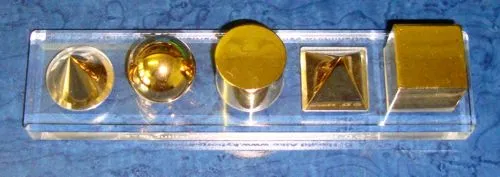
Art object. A work by D. Harald Alke (2013) from the Kyborg Institute. Background knowledge: encyclopedia entries energy and Feng Shui; more works → Art & Magic.
“The Art of Archimedes” is a small spiritual art object: five gold geometric solids on a transparent acrylic base. It is a homage to Archimedes of Syracuse – and to an attitude that runs through the whole work of the Kyborg Institute: insight arises from mind and craft, from thinking and one’s own experience.
The story behind the object
As a 16-year-old, D. Harald Alke heard from his mathematics teacher a story that never let go of him: the scholars of antiquity tried to determine purely by thought how the volume and surface of cone, sphere, cylinder, pyramid and cube can be calculated – and got no further. Archimedes had the solids made of heavy ebony, immersed them in water and measured the displaced amount. In this way he found: cone, sphere and cylinder are in the ratio of 1 : 2 : 3 by volume, pyramid and cube as 1 : 3.
His teachers were outraged that he had “sullied the pure humanities with matter” – and expelled him from the university. For the young Harald, that was precisely the lesson: where purely thinking gets you no further, the practical path is worthwhile – the formula then finds itself.
The object
D. Harald Alke translated the idea into an object in 2013: five turned solids (cone, sphere, cylinder, square pyramid, cube), each 3 cm in base measurement, made of brass, nickel-plated and gilded, on an acrylic base – whose clear mass symbolises the water into which Archimedes immersed his solids. Five objects, five metals (zinc, tin, copper, nickel, gold), five overlapping vibrations.
How to work with the object
- Re-enact Archimedes: place the solids one after another in a measuring jug and follow the volume ratio yourself – a 2,280-year-old proof, repeated with your own hands.
- Weigh them: the weights follow the same proportions (1 : 2 : 3 and 1 : 3).
- Sensitivity game: arrange the solids differently – aligned with the compass, one in the centre, four outside – and sense how the mood shifts with each arrangement.
What appeals to the seeker of meaning
The object is a quiet invitation to the sovereignty of your own insight: not to believe, but to test for yourself – with mind and hand. “Every kind of art has its effect,” says D. Harald Alke; art moves, awakens moods, brings new thoughts. That is precisely what he calls expansion of consciousness.
Frequently asked questions
What is “The Art of Archimedes”? A spiritual art object by D. Harald Alke: five small gold solids (cone, sphere, cylinder, square pyramid, cube, each 3 cm) on a transparent acrylic base – a homage to Archimedes and to insight through mind and craft.
What is Archimedes’ experiment about? Archimedes determined the volume of geometric solids by immersing them in water and measuring the displaced amount. It turned out that cone, sphere and cylinder of the same height and diameter are in the ratio of 1 : 2 : 3 by volume, pyramid and cube as 1 : 3.
How do you work with the object? You can repeat Archimedes’ proof yourself with a measuring jug, weigh the solids – or arrange them differently as a “sensitivity game” with the compass and sense the different mood each time. This is a worldview-based, experience-related view.
Note: “The Art of Archimedes” is a spiritual art object and not a medical device. The effects described are personal, worldview-based experience.